 LYCIAN STONES
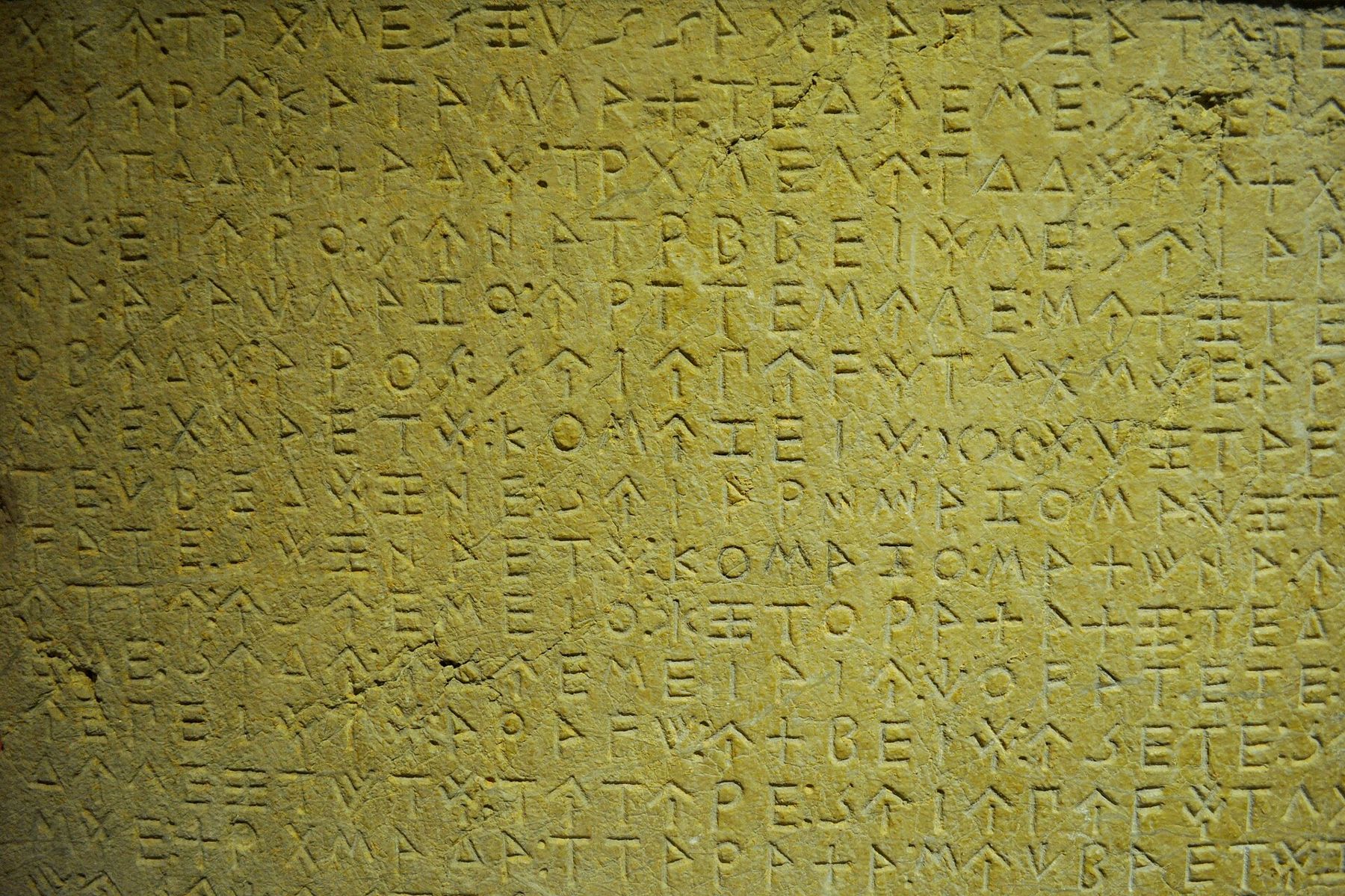
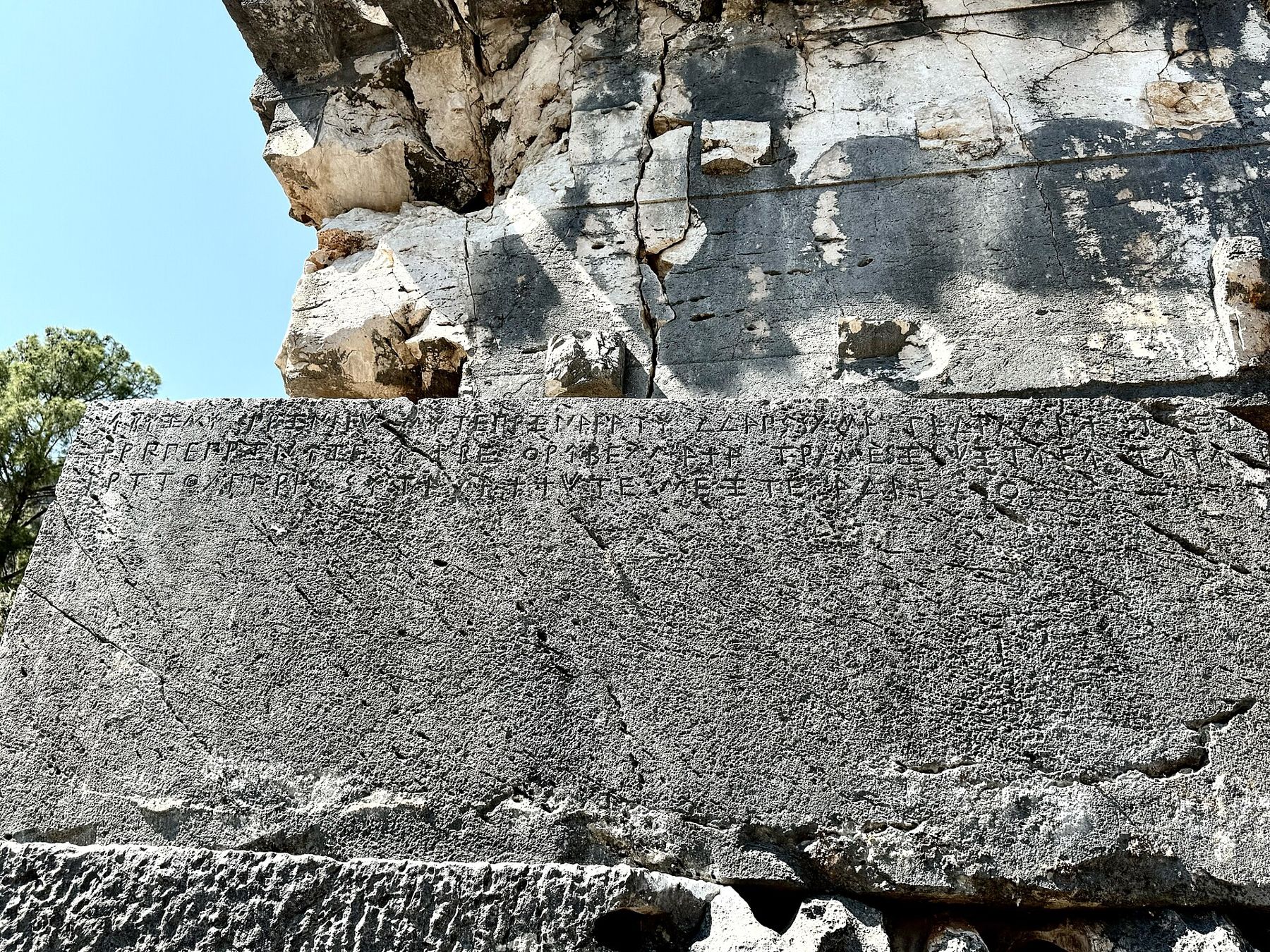
Walk among the tombs of Xanthos, Pinara or Myra and sooner or later you find lines of carved letters on a sarcophagus lid or above a rock-cut doorway. Some of the shapes are familiar: an E, a T, a P, an M. Others are not, and the words make no sense to a reader of Greek. This is Lycian, the language of the people who called themselves the Trm̃mili, written in an alphabet of their own.
It is worth learning to recognise, because it tells you something no amount of masonry can: who built a tomb, for whom, and sometimes who ruled. It is also a lesson in the limits of what is known. Lycian can be read aloud with reasonable confidence, much of its grammar is understood, and the meaning of the common tomb texts is clear. But many words remain uncertain, and some texts are only partly understood.
A language of Anatolia
Lycian belongs to the Anatolian branch of the Indo-European languages, the group that includes Hittite and Luwian. It is closely related to Luwian, which was spoken across southern Anatolia in the second millennium BC, and Lycian is generally seen as a later descendant of a Luwian-type language. Two forms are known. The common one, often called Lycian A, appears on most inscriptions. A second, Lycian B or Milyan, survives in only a few texts and is far less understood.
What survives is almost all written in stone or struck on coins. The stone inscriptions number fewer than two hundred, and the great majority are on tombs. A few are public texts: decrees, dedications and the long record on the pillar at Xanthos. No literature in Lycian has come down to us, no letters on papyrus, nothing written by ordinary people about their daily lives. You are reading the voice of a landowning class that wanted its tombs and its deeds remembered.
An alphabet borrowed and extended
The Lycian alphabet was adapted from a Greek alphabet, probably through contact with Greek communities on the coasts of southwest Anatolia and the islands. Lycian writers kept many Greek letters, sometimes for different sounds, and added signs of their own for sounds Greek lacked, including nasal vowels. The result has close to thirty letters. It is written from left to right, and words are separated by a divider of two or more stacked dots, a habit that makes Lycian text easy to spot on a weathered stone.
The script was used for a fairly short time. Almost all dated or datable inscriptions belong to the 5th and 4th centuries BC, the period of the local dynasts who ruled under Persian overlordship. After Alexander's conquest in the 330s BC and the spread of Greek as the language of power and display, Lycian writing fades from the record. Within a few generations, public inscriptions in Lycia were written in Greek, and the language itself seems to have died out as a spoken tongue some time after, though when exactly is not known.
The tomb formula
Most Lycian inscriptions follow a pattern, and once you know it the texts become less mysterious. A typical one names the tomb, then the person who built it, then those for whom it was made: in effect, this tomb, so-and-so built it, for himself, his wife and his children. Some add a warning against anyone who places another body inside, and a few name a penalty or invoke the gods against the offender.
Because the formula repeats with different names, it was one of the keys to understanding the language. Short Greek versions on some tombs, giving the same information side by side, allowed early scholars to match words and test their readings. You will find these bilingual tombs at several sites, and reading a Lycian tomb explains where on a facade or sarcophagus the text usually sits. At Pinara the inscription on the sarcophagus of Ddapssm̃ma runs in three lines along the side of the chest, a good example of the form.
The Letoon trilingual
The single most important text for Lycian was found in 1973 at the Letoon, the sanctuary of Leto near Xanthos. It is a stone stele inscribed in three languages: Lycian on one face, Greek on another, and a shorter Aramaic text on a side. The stele records the founding of a cult at Xanthos for two gods, the arrangements for its priest and the income set aside for it, under the authority of Pixodaros, son of Hekatomnos, the Carian ruler who then held Lycia for the Persian king. It belongs to the 4th century BC; the exact year is debated.
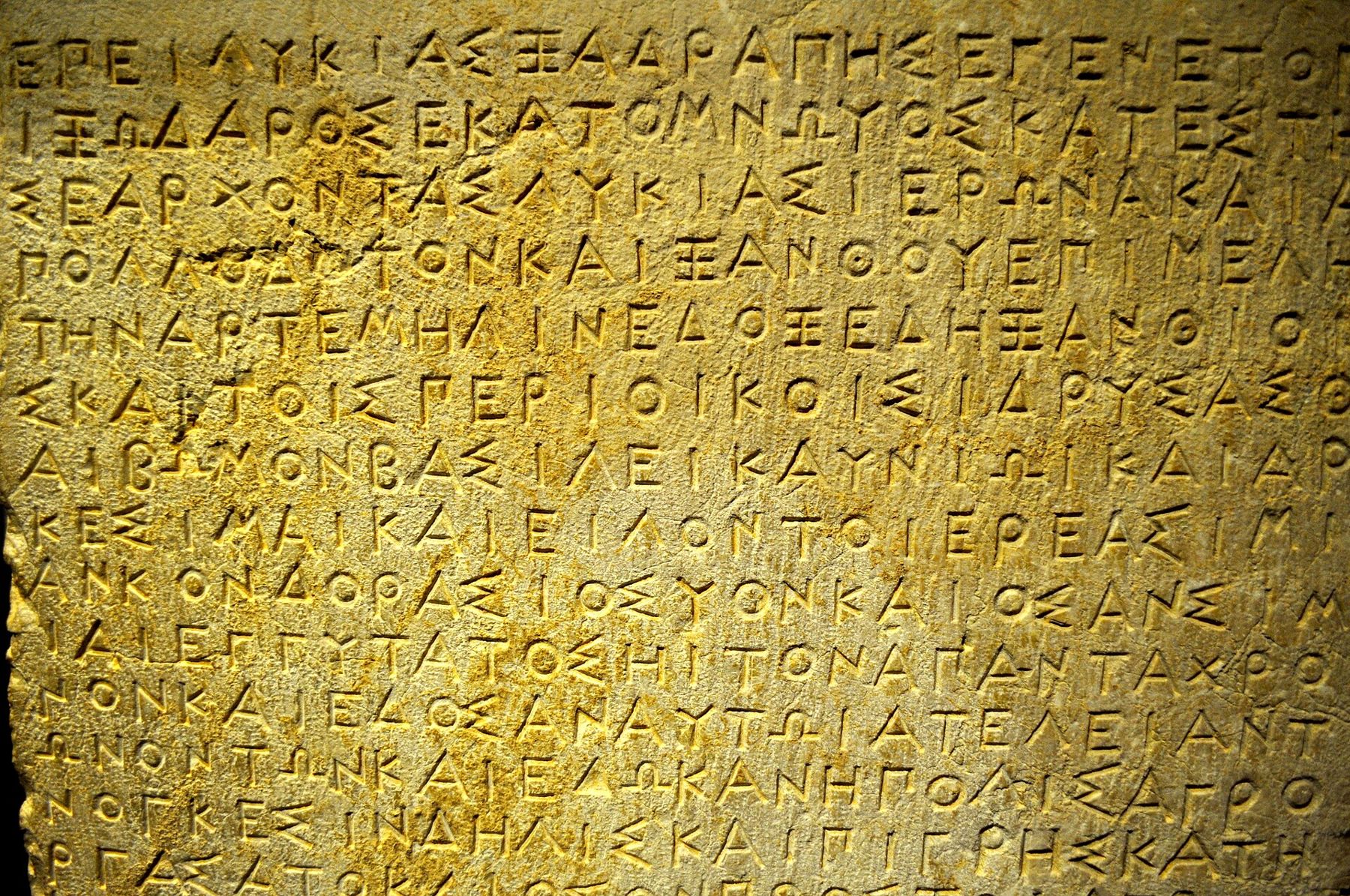
The Lycian and Greek versions are close enough to each other to work as a long parallel text, far longer than any tomb bilingual, and they confirmed many readings and added new words. The Aramaic, the administrative language of the Persian empire, is not a straight translation but a summary in the form of an official approval. The stele is now kept in the Fethiye Museum. If you have stood among the temples at the Letoon, seeing the stone itself closes the circle: the place where it stood and the words that governed it.
The Inscribed Pillar at Xanthos
The other great Lycian text still stands where it was raised, at Xanthos. The Inscribed Pillar is a tall stone shaft that once carried a grave chamber and sculpture on its top, now lost. Its four sides are covered with the longest Lycian inscription known, more than two hundred lines, set up in the late 5th century BC for a local dynast. Most of it is in Lycian A, but one long part is in Lycian B, and among the Lycian lines is a short Greek poem in verse praising the dynast's deeds.
This is where the limits of understanding show most clearly. The Greek verses can be read. The Lycian text is known to tell of wars, victories and the dynast's family, and names and some passages can be followed, but much of it cannot yet be translated with confidence, and the Lycian B section is understood least of all. Which ruler the pillar commemorates is still discussed. Stand at its foot and you are looking at a historical record that has been read aloud for over a century and is still only partly understood.
Where to see the letters
- Xanthos: the Inscribed Pillar beside the agora, and short texts on tombs around the site.
- Fethiye Museum: the Letoon trilingual, with Lycian inscriptions and tomb finds from the region.
- Pinara, Tlos and Myra: inscriptions on sarcophagi and above rock-cut tomb doors.
- Coins: museum cases across the region, including at the Antalya Museum, often show dynasts' names in Lycian letters.
Many texts are high up or worn by weather, and the best light comes early or late in the day, when shadows fall into the cut letters. Binoculars help with tombs set high in cliffs. Museum opening hours and site fees change, so check before you go, and on open sites remember that summer midday is dangerous: carry water and keep the reading for the cooler hours.