 LYCIAN STONES
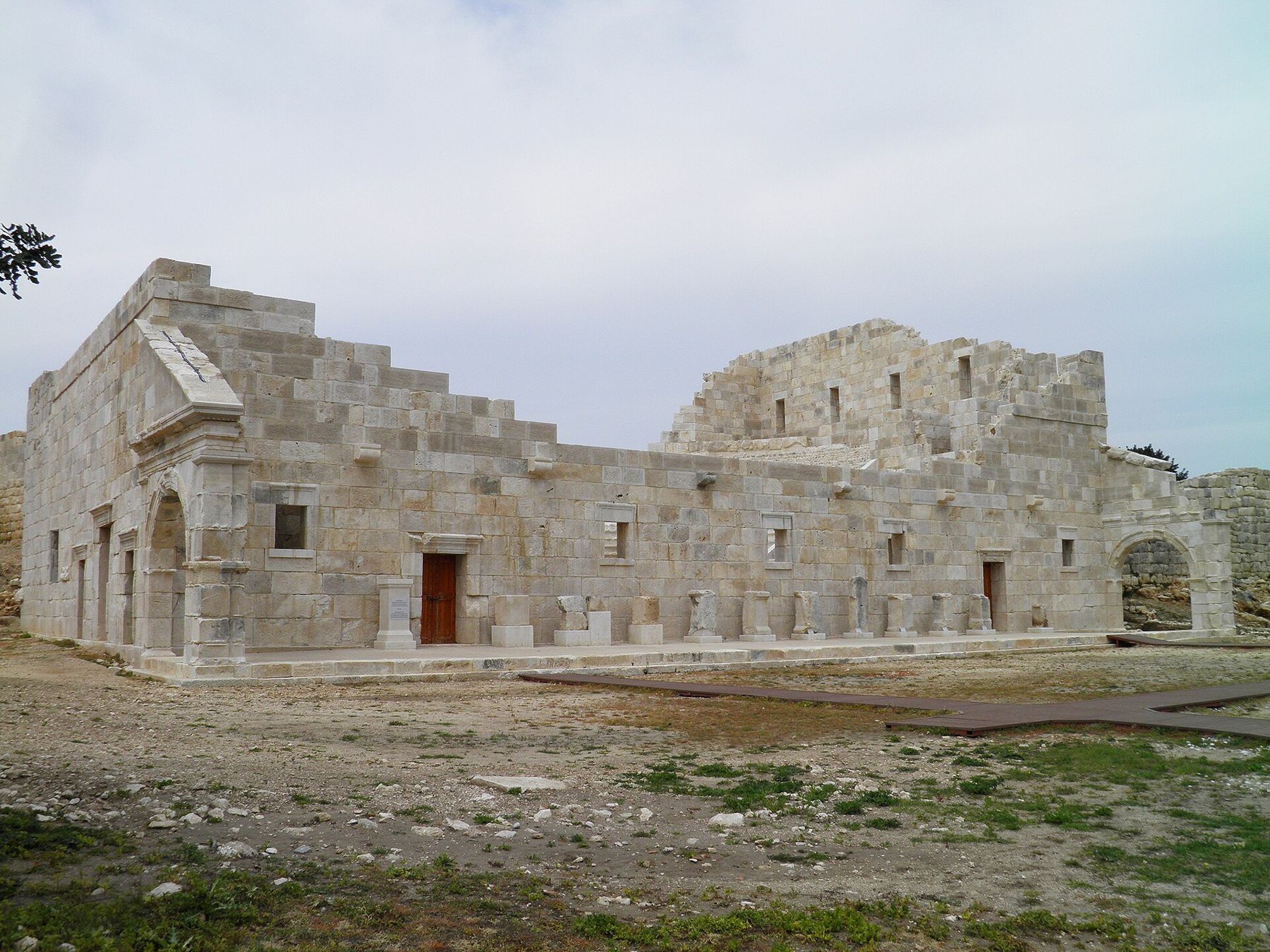
Patara was one of the principal cities of ancient Lycia and its chief port. It stood near the mouth of the Xanthos river, close to the sea, and it was the gateway through which Lycia traded with the wider Mediterranean. Today its harbour has silted up into marsh and sand, and the ruins lie among dunes and low scrub behind a long beach. Excavation and restoration have brought much of the city back into view, including two remarkable buildings: the council hall associated with the Lycian League and a Roman lighthouse.
Ancient writers mention an oracle of Apollo at Patara, and in Christian tradition the city was the birthplace of Saint Nicholas, later bishop of Myra. The visible remains are mainly from the Roman period.
The Lycian League and its hall
The Lycian League was a federation of cities that governed the region's common affairs. Strabo describes it as having over twenty member cities, with the six largest, Xanthos, Patara, Pinara, Olympos, Myra and Tlos, holding three votes each and smaller cities two or one. Delegates met in a common council, and Patara's bouleuterion, its council house, is thought to have been one of the places where they gathered.
The bouleuterion was restored in the 2010s and now stands with its walls rebuilt to a good height. Inside, the seating rises steeply in a semicircle, facing a speaker's platform. The building is often presented as an early parliament, and it is the clearest surviving image of a political system based on weighted representation rather than a single ruler.
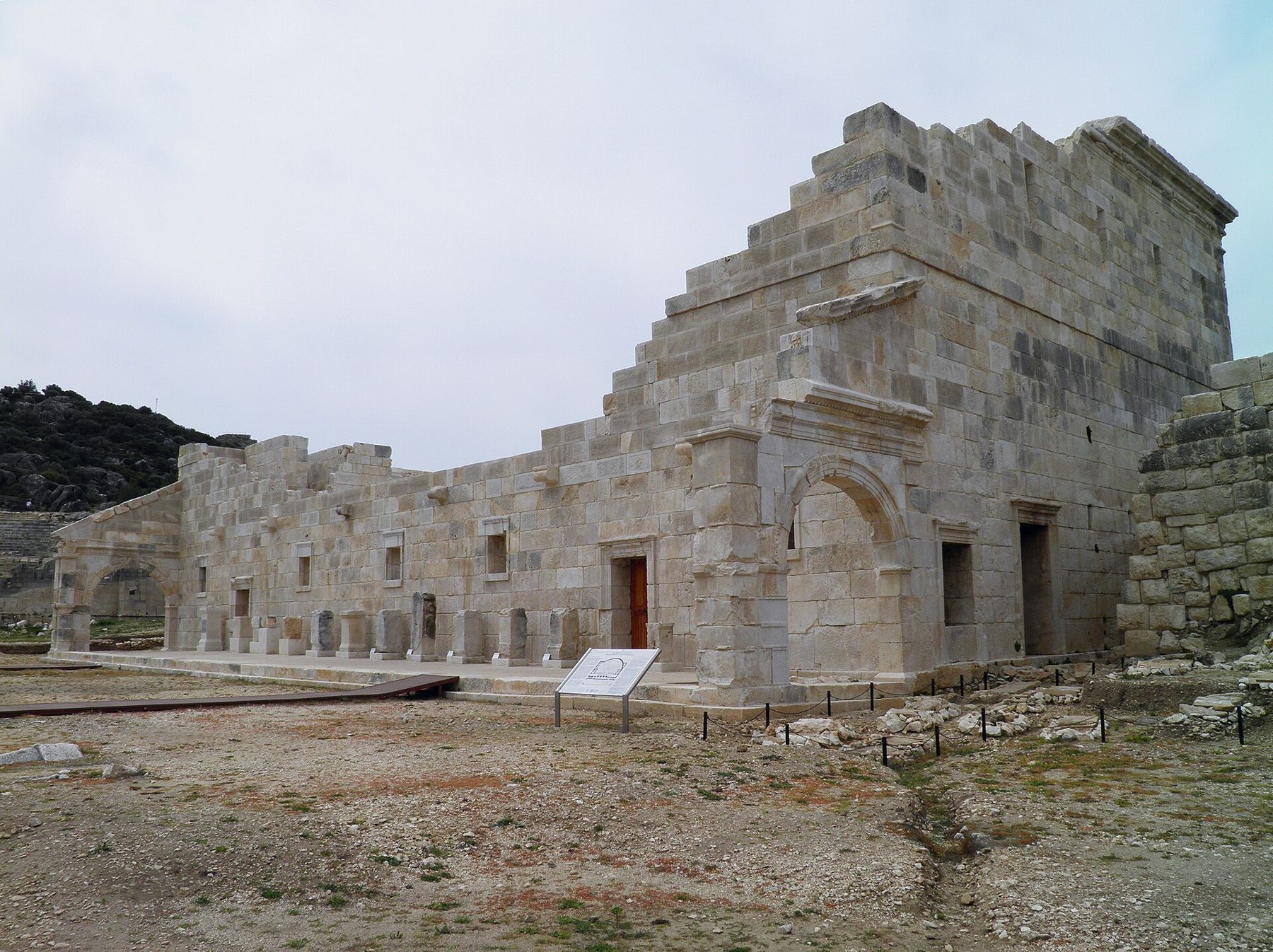
The restoration is extensive and has its critics, but it shows clearly how the hall worked. Sit on the upper rows and look down at the floor: the space is intimate, made for debate rather than spectacle.
The theatre and the main street
Next to the bouleuterion lies the Roman theatre, cut into the slope of a hill. Its stage building survives in part, and sand filled much of the lower seating over the centuries before excavation cleared it. Climbing the hill behind it gives a view over the whole site, the dunes and the sea.
From the theatre area a colonnaded main street runs north. Columns have been re-erected along part of its length, with shops opening off it. At the northern edge of the city, a triple-arched Roman gateway marks the old entrance, and the road from the village passes close to it.
The gate is worth a slow look. Its three arches stand almost complete, and an inscription on it is generally read as linking the gate to a Roman governor of the province around the turn of the first and second centuries AD. Outside it, as at most Lycian cities, the dead were buried along the approach road: you pass sarcophagi and tomb foundations among the scrub before you reach the arches, a reminder that arriving at an ancient city meant first walking through its cemetery.
The lighthouse
Near the old harbour mouth, excavators found the remains of a Roman lighthouse. It dates to the first century AD, in the reign of Nero, and an inscription records its dedication. It is counted among the oldest lighthouses whose remains survive.
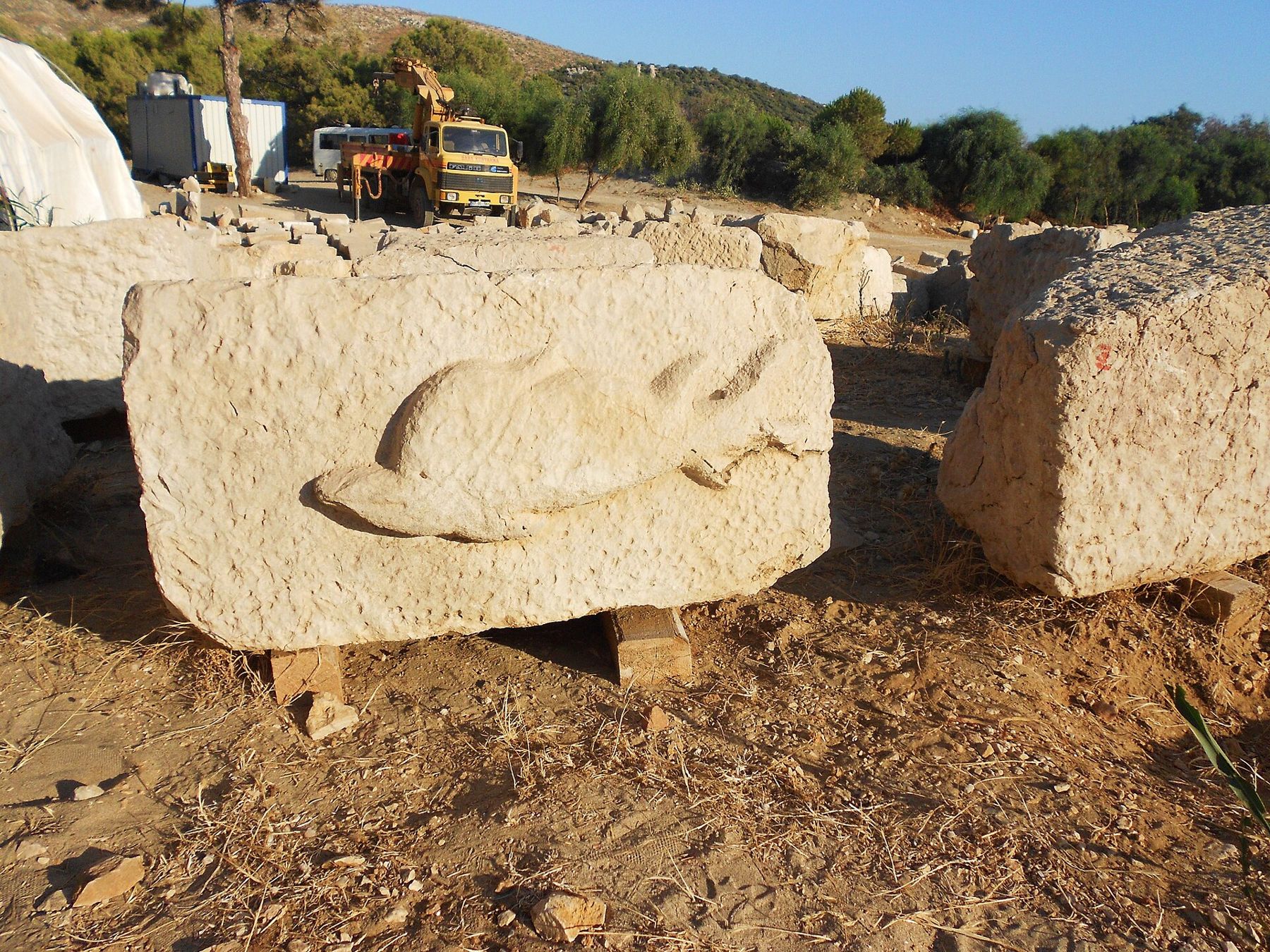
The lighthouse had collapsed, but many of its stones lay where they fell, and it has been partly rebuilt. Carved and inscribed blocks from the city still lie around the excavation areas.
From the lighthouse you look across what was the harbour. It is now dry land, marsh and sand, a reminder of how the river's silt slowly closed the port.
The granary and the harbour
On the far side of the harbour basin stands a large Roman granary, built in the second century AD in the reign of Hadrian. It stored grain for the city and for shipping, and its long walls still stand. Reaching it means walking around the edge of the marsh, along paths that can be wet after rain.
Grain was the lifeblood of Roman sea trade, and a building of this size tells you how much passed through Patara. Stand at its doorway and imagine the basin in front of you full of ships rather than reeds.
Dunes and the shore
Behind the ruins, the dunes run down to a long sandy beach. The beach is protected as a nesting ground for loggerhead turtles, and access is controlled, especially at night in the nesting season. Respect the rules on site.
The dunes are part of the story of the ruins: sand buried much of the city and still drifts over the paths. Late in the afternoon, when the light is low and the wind drops, the colours of the stone and the sand come closest together.
Patara as a starting point
Patara makes a good base for western Lycia. Xanthos and the Letoon are a short drive inland, and the village of Gelemiş beside the ruins gives access to the site. The Lycian Way passes through the area, and the coastal walking towards Kalkan and Kaş begins not far away.
- Entry fees and opening hours change; check before you go.
- Allow two to three hours for the main ruins.
- The site is open and sunny; take water and avoid the middle of a summer day.
Before you leave, go back to the bouleuterion. It is easy to admire theatres and temples, but this plain hall, where delegates from twenty or more cities may have come to vote, could be the most important building in Lycia.