 LYCIAN STONES
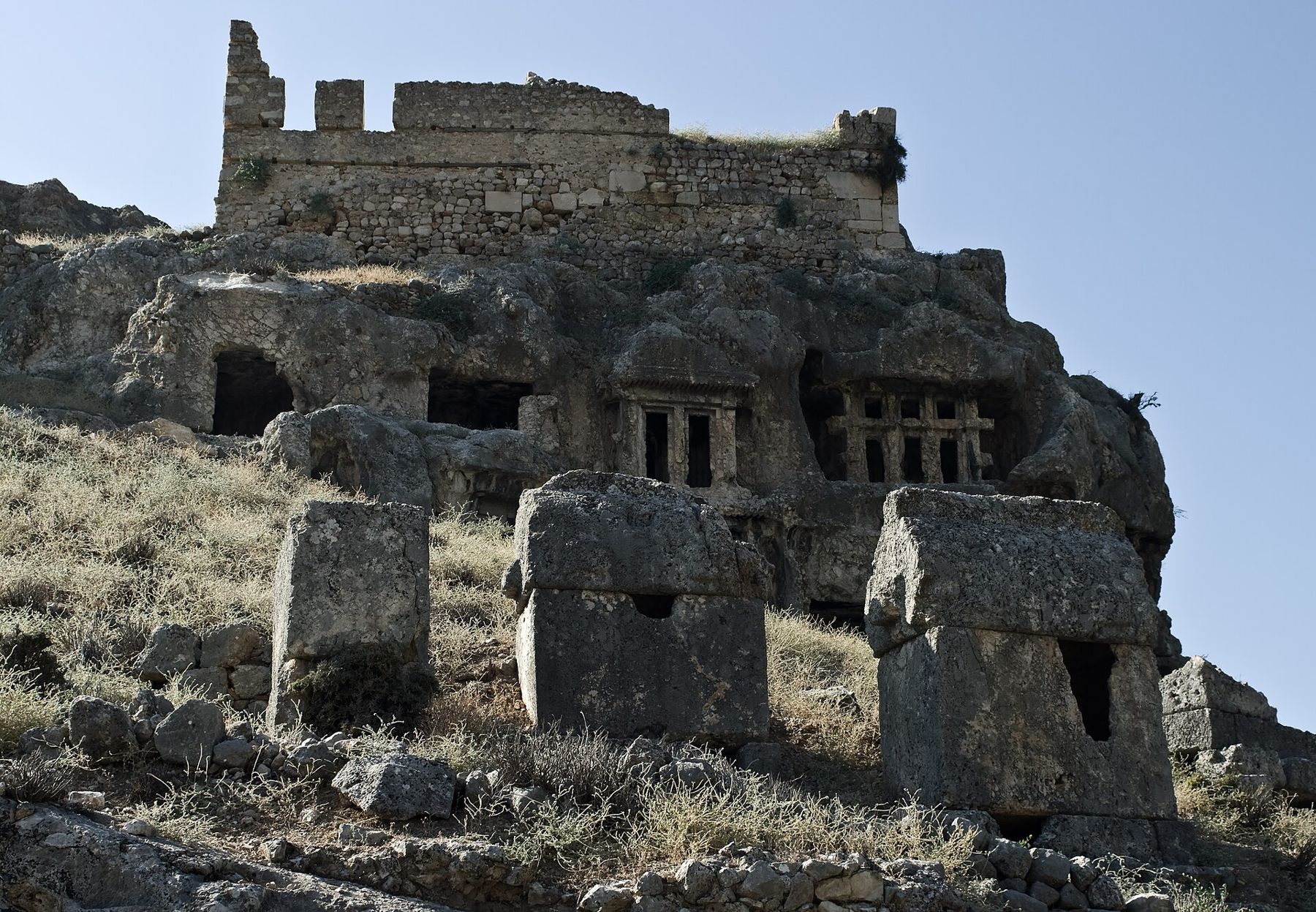
No region of the ancient Mediterranean is as full of tombs as Lycia. They stand on hilltops, in the middle of fields, beside the sea and high on cliff faces, sometimes in the hundreds above a single city. For a visitor the sheer number can blur into one impression of carved rock. It helps to know that most of them belong to a few clear types, and that each type tells you something about how the Lycians thought of the dead.
Most of the monumental tombs date from roughly the sixth to the fourth centuries BC, when Lycia was ruled by local dynasts under Persian overlordship, with the sarcophagus continuing in use long into the Roman period. Many carry inscriptions in the Lycian language, written in an alphabet related to Greek, naming the owner and those allowed to be buried with them. The language itself is covered in the Lycian alphabet and bilingual stones; here the subject is shape.
Pillar tombs: the oldest and the highest
The pillar tomb is the earliest monumental type and the rarest. A tall stone shaft stands on a base, and at the top, raised far above the ground, sits a small burial chamber closed with a heavy capstone. These were tombs for rulers and the very powerful, and they belong mostly to the sixth and fifth centuries BC.
Xanthos is the place to see them. Beside the theatre stands the Harpy Tomb, a pillar whose chamber was carved with reliefs of winged figures carrying small human forms; the originals are in the British Museum and casts are in place. Nearby is the Inscribed Pillar, covered on all sides with a long text, mostly in Lycian with a passage in Greek verse. Neither is easy to read on the spot, but standing beneath them you understand the idea at once: the dead ruler lifted above the city, between earth and sky.
House tombs: timber turned to stone
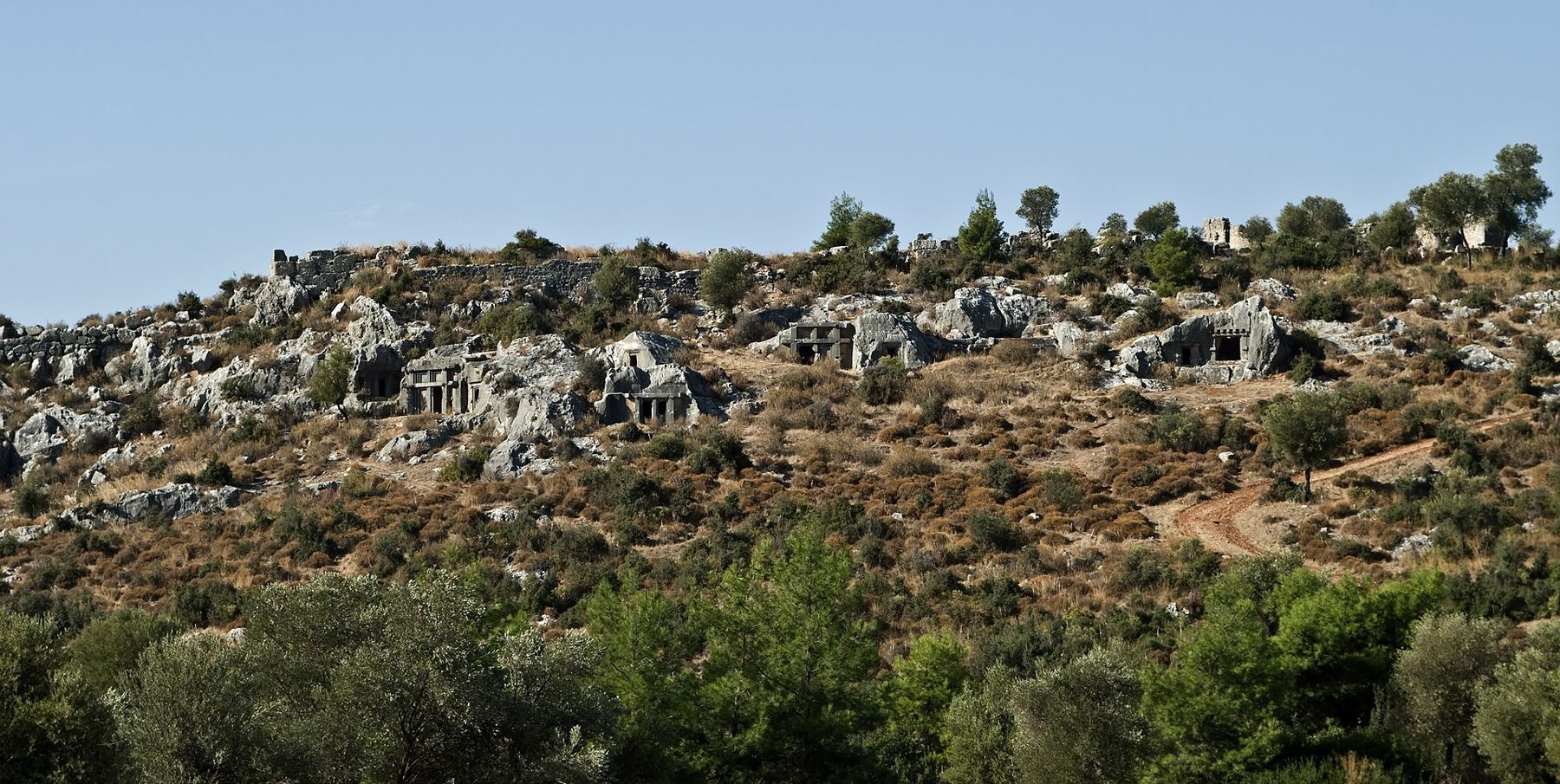
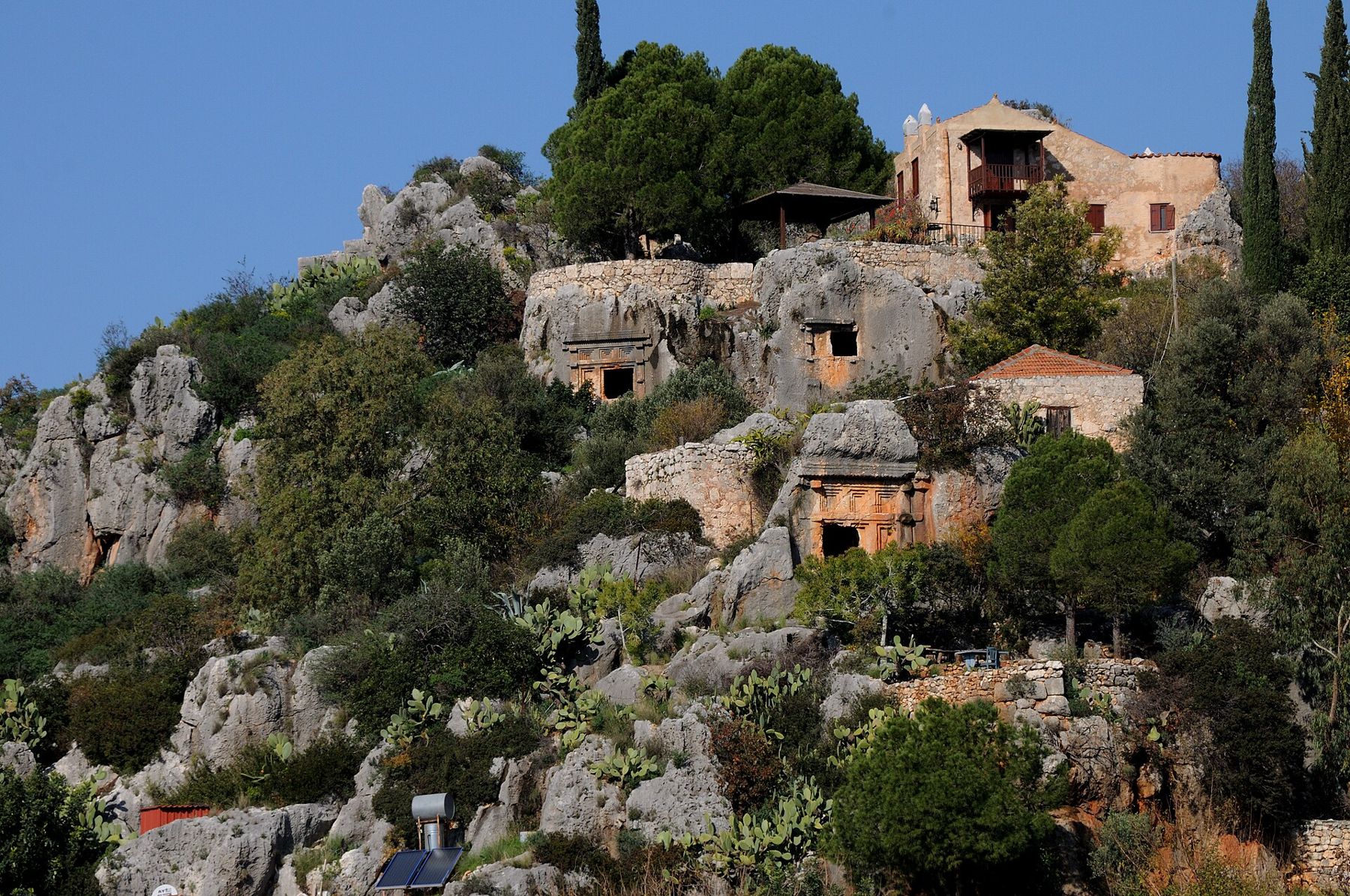
The most common Lycian tomb is the rock-cut house tomb. Masons cut a façade into a cliff or a boulder that copies, in stone, the front of a timber house: upright posts, cross beams, framed panels and a roof of logs whose round ends project along the top. Behind the façade is a small chamber with stone benches for the dead. Some have flat roofs, some a gabled roof; a few are carved with reliefs of the owner, family scenes or funeral meals.
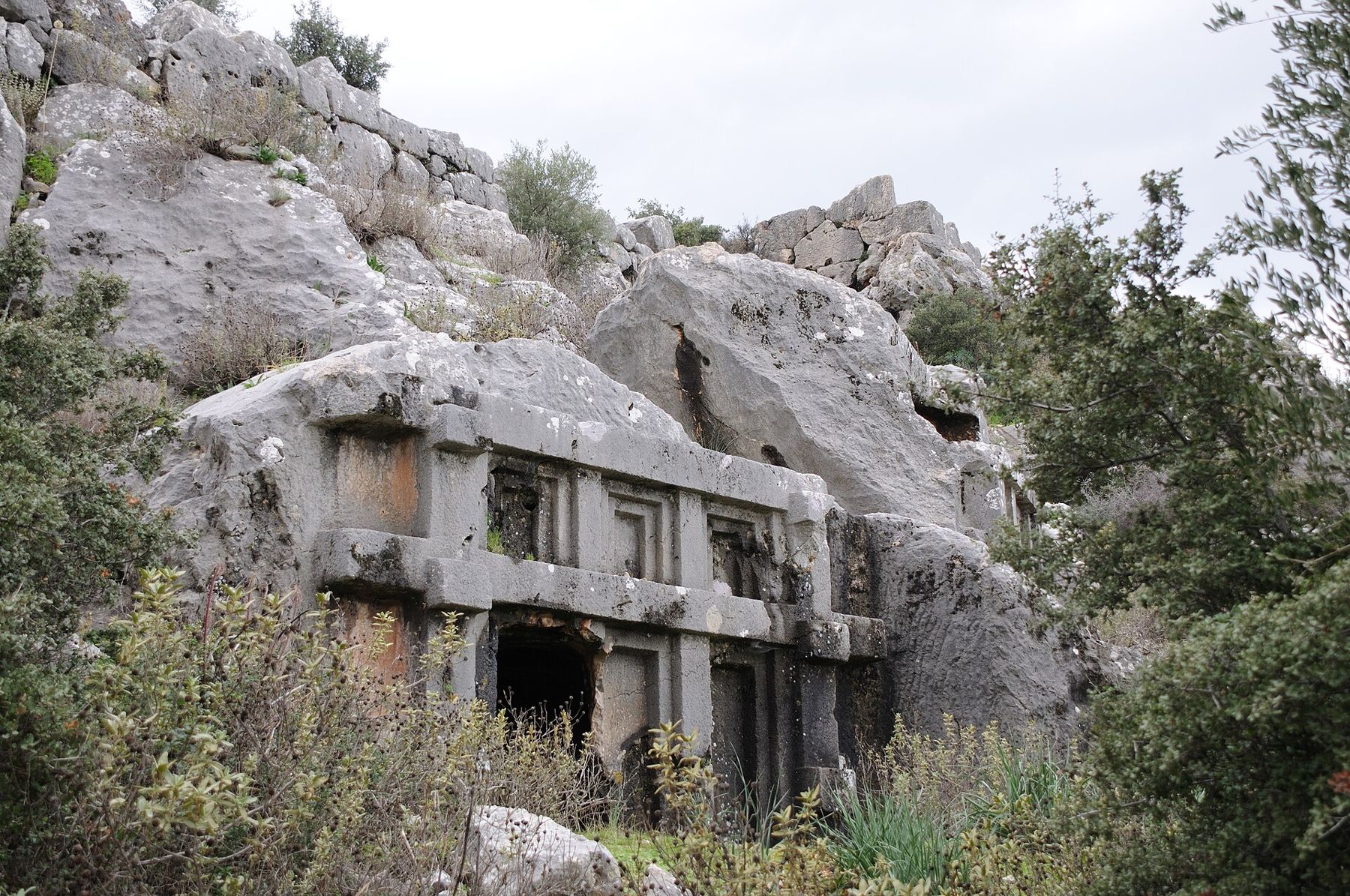
What they copy is the interesting part. No Lycian timber houses survive, so these tombs are the best record of how they were built, joint by joint. Some details can still be seen in traditional granaries in the region, which use the same system of beams and notched joints. Look closely at a façade and you can count the logs, follow the frame and see the door panels carved as if they could swing open.
The finest groups are at Myra, where two cliffs of house tombs rise above the theatre, and at Tlos and Pinara, where tombs are cut high on the rock below the acropolis. Traces of paint have been recorded on some façades, a reminder that they were once coloured.
No Lycian timber houses survive, so these tombs are the best record of how they were built, joint by joint.
Temple tombs: the Greek front
From the fourth century BC some Lycians chose a different model for their tombs: the front of a Greek temple. A pair of columns stands between side walls, an entablature runs above them and a triangular pediment crowns the whole, all carved from the living rock. The style shows how far Greek forms had spread into Lycian society, even as the language of many inscriptions stayed Lycian.
The best-known example is the tomb of Amyntas at Fethiye, the ancient Telmessos, cut high in the cliff above the modern town with Ionic columns and a Greek inscription naming its owner. It is reached by steps and is often visited in the late afternoon, when the light falls on the façade. Smaller temple tombs appear at Pinara and Tlos, sometimes side by side with house tombs, as if two fashions were in use at the same time.
Sarcophagi with pointed lids
The Lycian sarcophagus is the type you will see most often in the open, beside roads, in fields and even standing in the sea. It is built in layers. At the bottom is a base, sometimes holding a lower chamber for servants or relatives. Above it is the stone chest for the main burial, and on top sits the most recognisable feature of all: a high lid shaped like a pointed arch, often compared to an upturned boat or a Gothic arch, with a ridge along the top.
What the lid copies is debated. It may imitate a curved wooden roof, or carry a meaning that is now lost. Many lids have projecting bosses on the sides, sometimes carved as lion heads, which may have helped in lifting the heavy stone. The best-preserved examples also carry reliefs of battles, hunts or the owner seated in state.
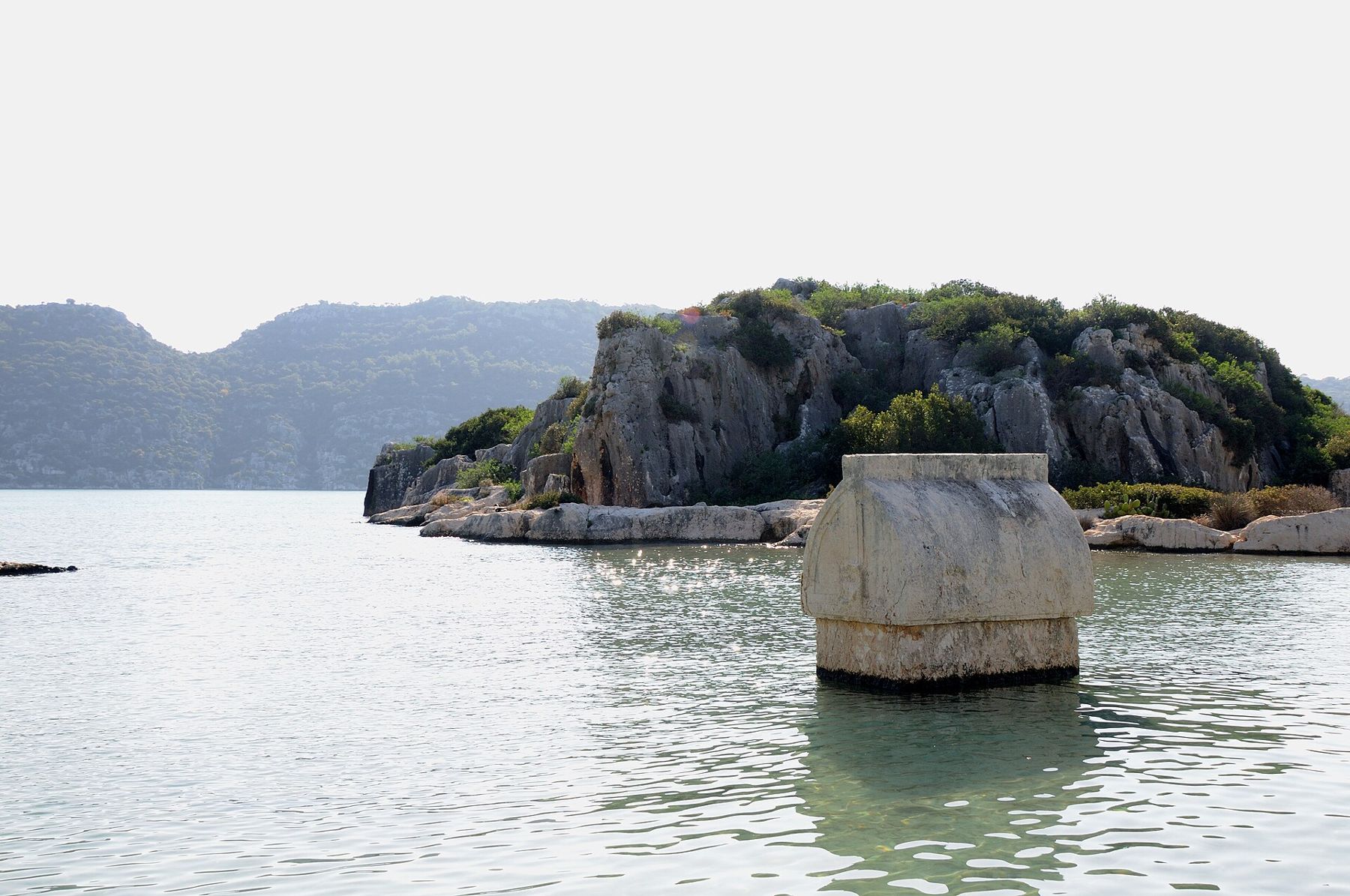
The sarcophagus standing in the water near Kaleköy, the ancient Simena, is the most photographed in Lycia, and shows how the land has sunk along this coast. It belongs to the landscape described in the sunken stones of Kekova. At Tlos, a group of sarcophagi stands below the acropolis, their lids broken or lifted long ago by robbers.
Reading a tomb on site
When you meet a tomb, ask a few simple questions. Is it a free-standing pillar, a façade cut into rock, or a chest on a base? If it is a façade, does it copy timber or a temple? Is there an inscription, and in which script? Is there a relief, and what does it show? These questions are enough to place most tombs in their type and approximate century.
- Use binoculars for cliff tombs; many are high and unsafe to approach.
- Do not climb into chambers or onto lids, and never sit on carved stone.
- Go in the early morning or late afternoon, when side light brings out carved detail.
- Entry fees and access to fenced sites change; check before you go.
Most tombs were opened and robbed long ago, and what remains is the architecture rather than the contents. Yet that is what the Lycians meant to last. They built their houses for the dead in stone so that they would stand for centuries, and many of them still do.