 LYCIAN STONES
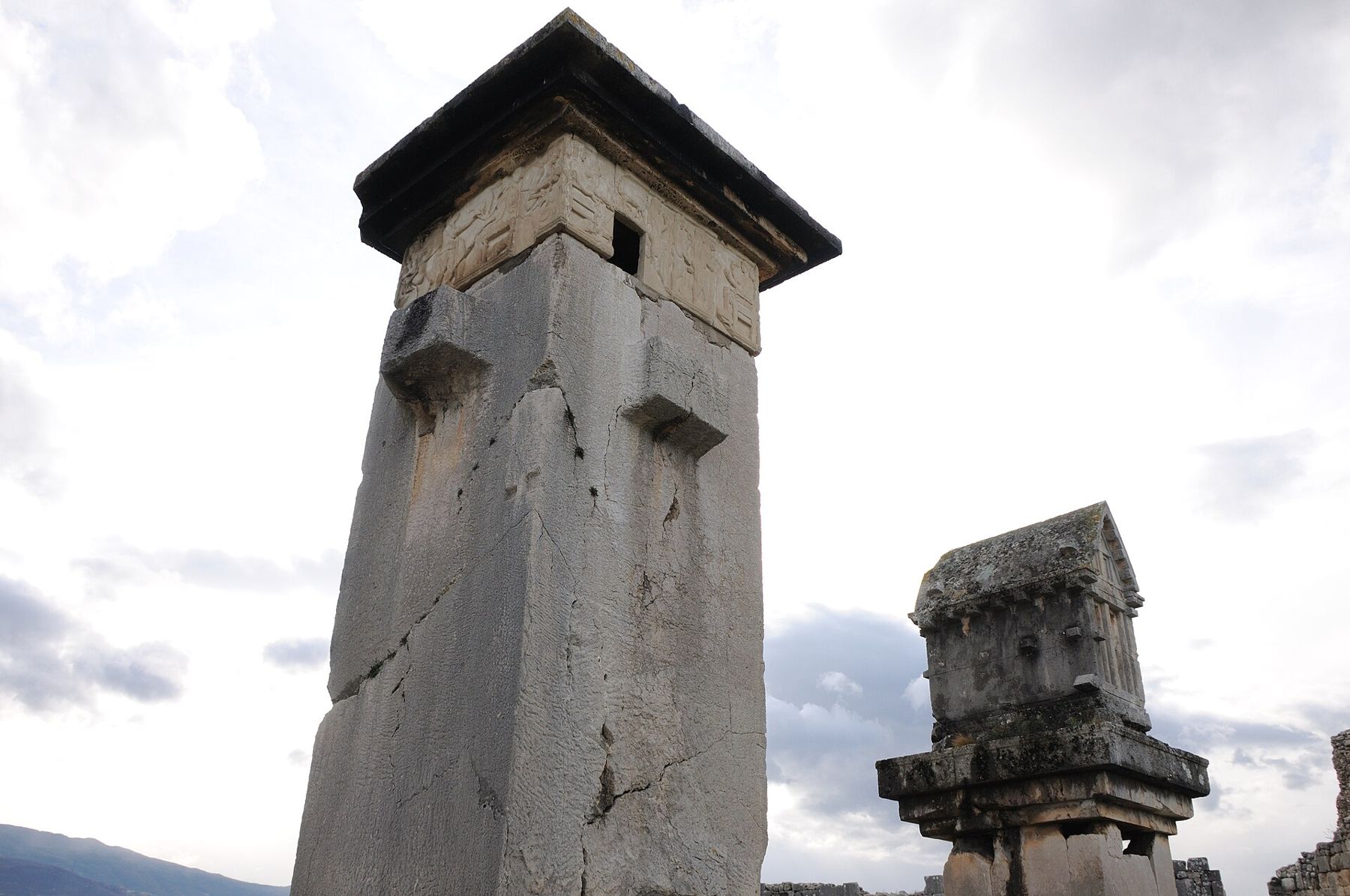
Xanthos was the leading city of ancient Lycia, and it reads like a textbook of the region's tomb types. Its hill above the Eşen Çayı, the river the Greeks called the Xanthos, carries pillar tombs, a sarcophagus raised on a pillar, rock-cut house tombs and Roman buildings laid over older ones. A few kilometres to the south-west lies the Letoon, the sanctuary of the goddess Leto that served the Lycians as their chief religious centre. The two were inscribed together as a UNESCO World Heritage Site, and they are best visited on the same day.
Xanthos has a dark place in ancient history. Herodotus tells of the Persian conquest of Lycia in the sixth century BC, when the Xanthians, facing defeat, are said to have destroyed their own families and possessions and died fighting. The city was rebuilt and flourished under Persian rule as the seat of a local dynasty, then in the Hellenistic and Roman periods, and it suffered again during the Roman civil wars of the first century BC. What you see is the accumulation of all these phases.
The Harpy Tomb and the pillar sarcophagus
Next to the Roman theatre stand the two monuments most people come to see. The tall one is the Harpy Tomb, a pillar tomb of the early fifth century BC: a single tall shaft of stone with a burial chamber at the top, once faced with carved marble panels. The reliefs show winged female figures carrying small figures, long called harpies, though they may represent other spirits that carried away the souls of the dead. The originals are in the British Museum; the panels you see on site are casts.
Beside it stands a second monument, a Lycian sarcophagus set on top of a tall pillar, combining two tomb types in one. Its lid has the curved, pointed shape typical of Lycian sarcophagi, which copies a roof of bent timber.
Its lid has the curved, pointed shape typical of Lycian sarcophagi, which copies a roof of bent timber.
The pairing of these two tombs, raised high above the ground on the edge of the theatre, says a great deal about Lycian ideas of death: the dead were lifted up and set where the living would see them every day. For a fuller explanation of the shapes, see the guide on how to read a Lycian tomb.
The theatre, the agora and the Inscribed Pillar
The Roman theatre was built into the slope of the acropolis. Its seating is partly preserved, and from the upper rows you look over the valley towards the mountains. North of the theatre lies the Roman agora, an open square.
At a corner of the agora stands the Inscribed Pillar, the most important single stone in Lycia. It is a pillar tomb of around 400 BC, and its four faces carry the longest known text in the Lycian language. The inscription is understood to record the deeds of a local ruler and his family; it is written mostly in the main form of Lycian, with a passage in a second, related dialect and a Greek verse epigram among the lines. Much of the Lycian text still cannot be read with confidence. The chamber at the top once carried reliefs, and a statue of the ruler probably stood above it.
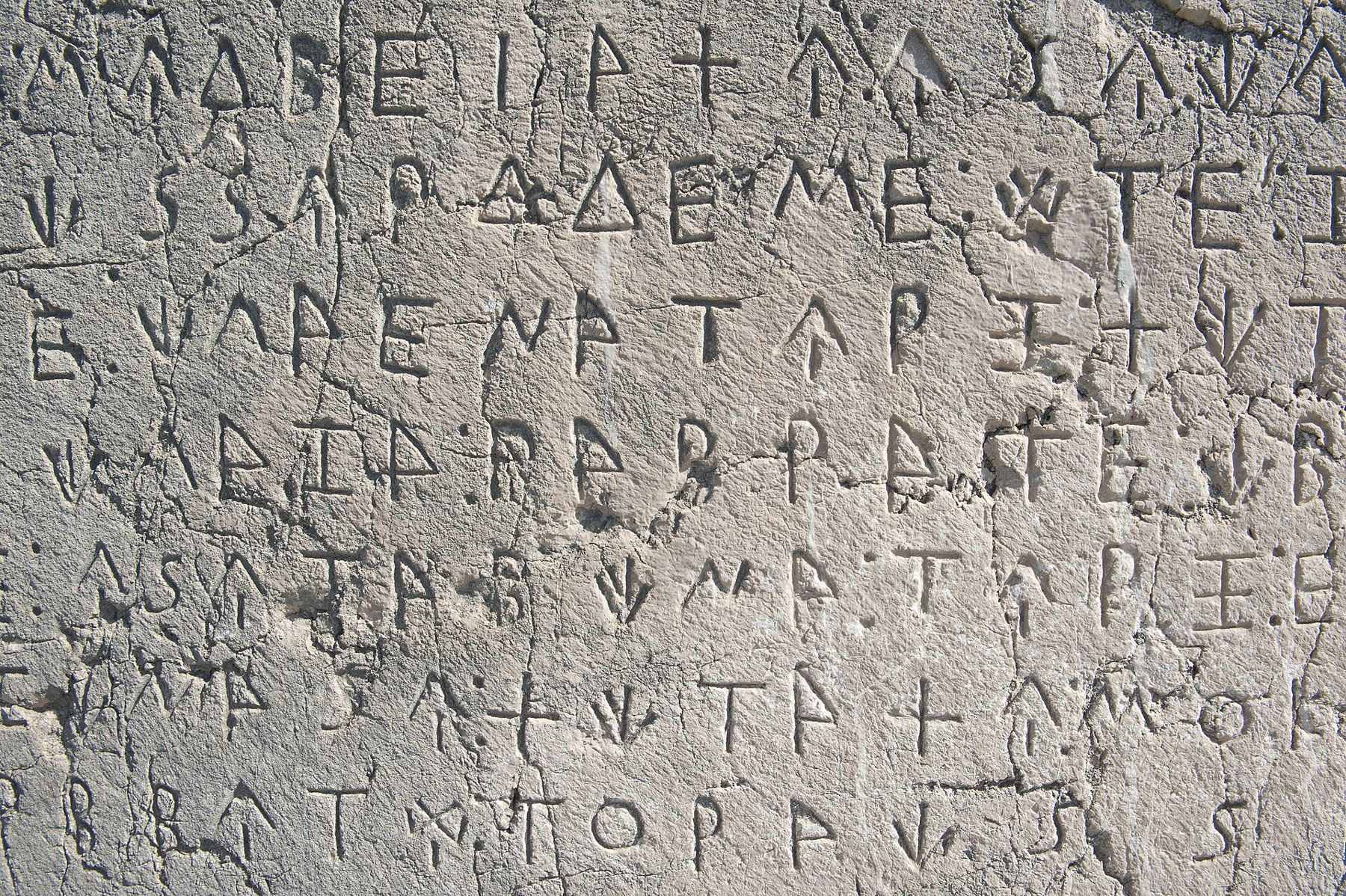
Study the letters closely. Many look like Greek, others are quite different, and the script shows how the Lycians adapted the Greek alphabet for their own language. The guide to the Lycian alphabet explains what can be read and what remains uncertain.
The hillside tombs and the acropolis
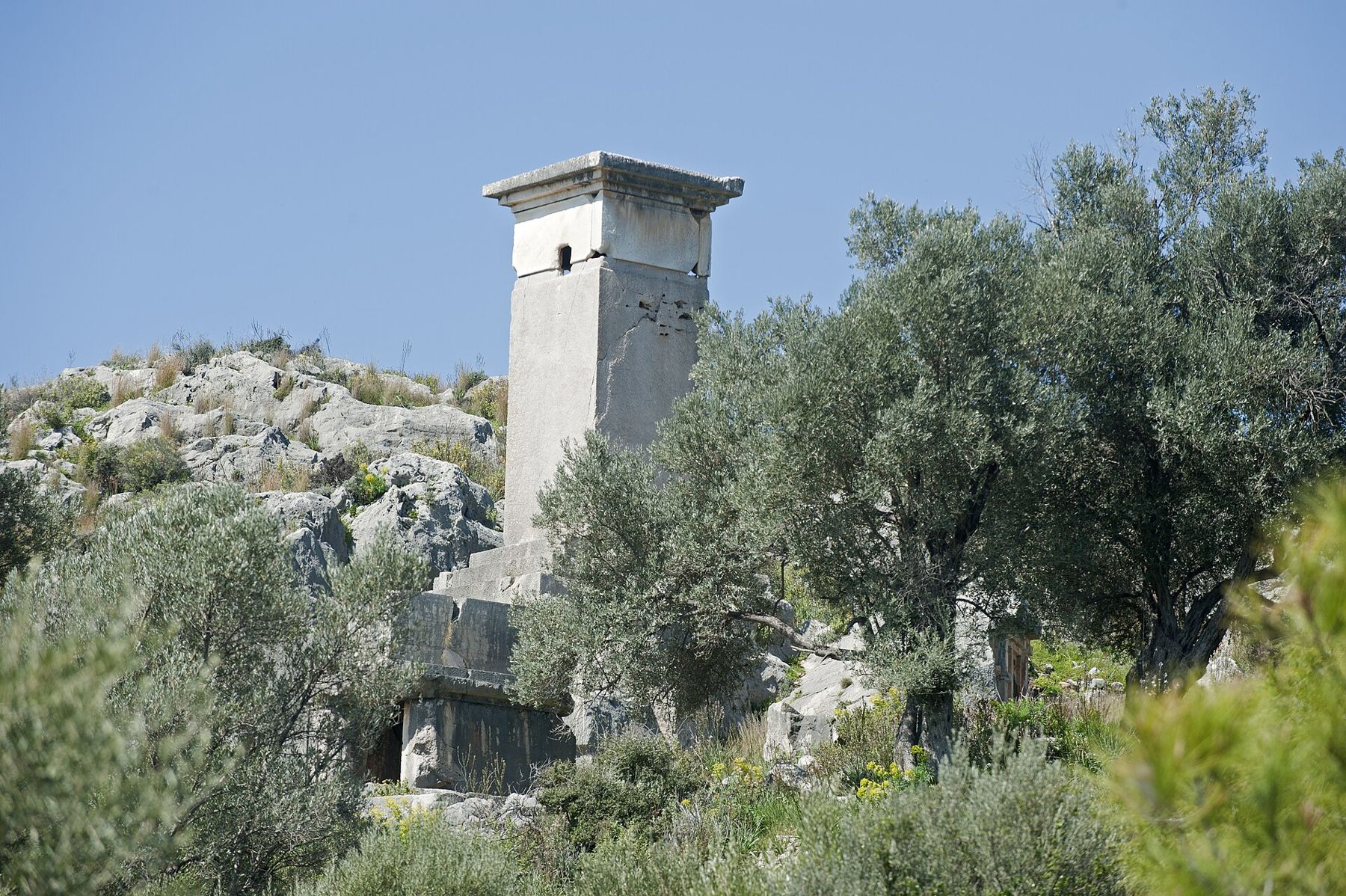
Around the city, on the slopes and in the rock faces, lie many more tombs: pillar tombs, house-shaped rock tombs and sarcophagi. Some stand alone among olive trees, others are cut into low cliffs.
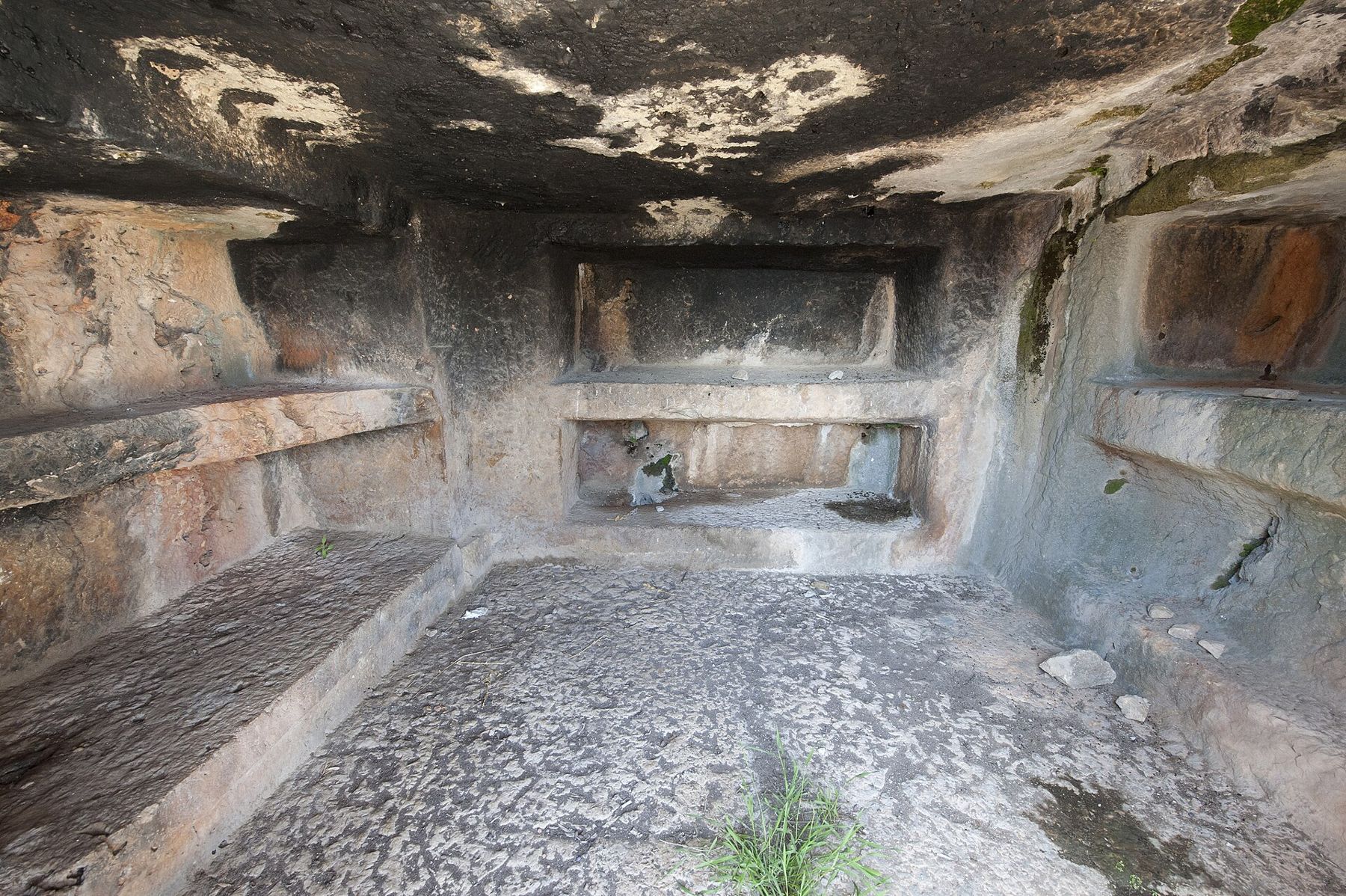
The rock tombs imitate timber houses, with carved beams and doorways. Look into one and you see the stone benches along the walls on which the dead were laid.
The Lycian acropolis, beside the theatre, holds the remains of early buildings usually linked to the dynasts who ruled the city. Its walls are fragmentary, but from its edge you get a good view down to the river and the plain.
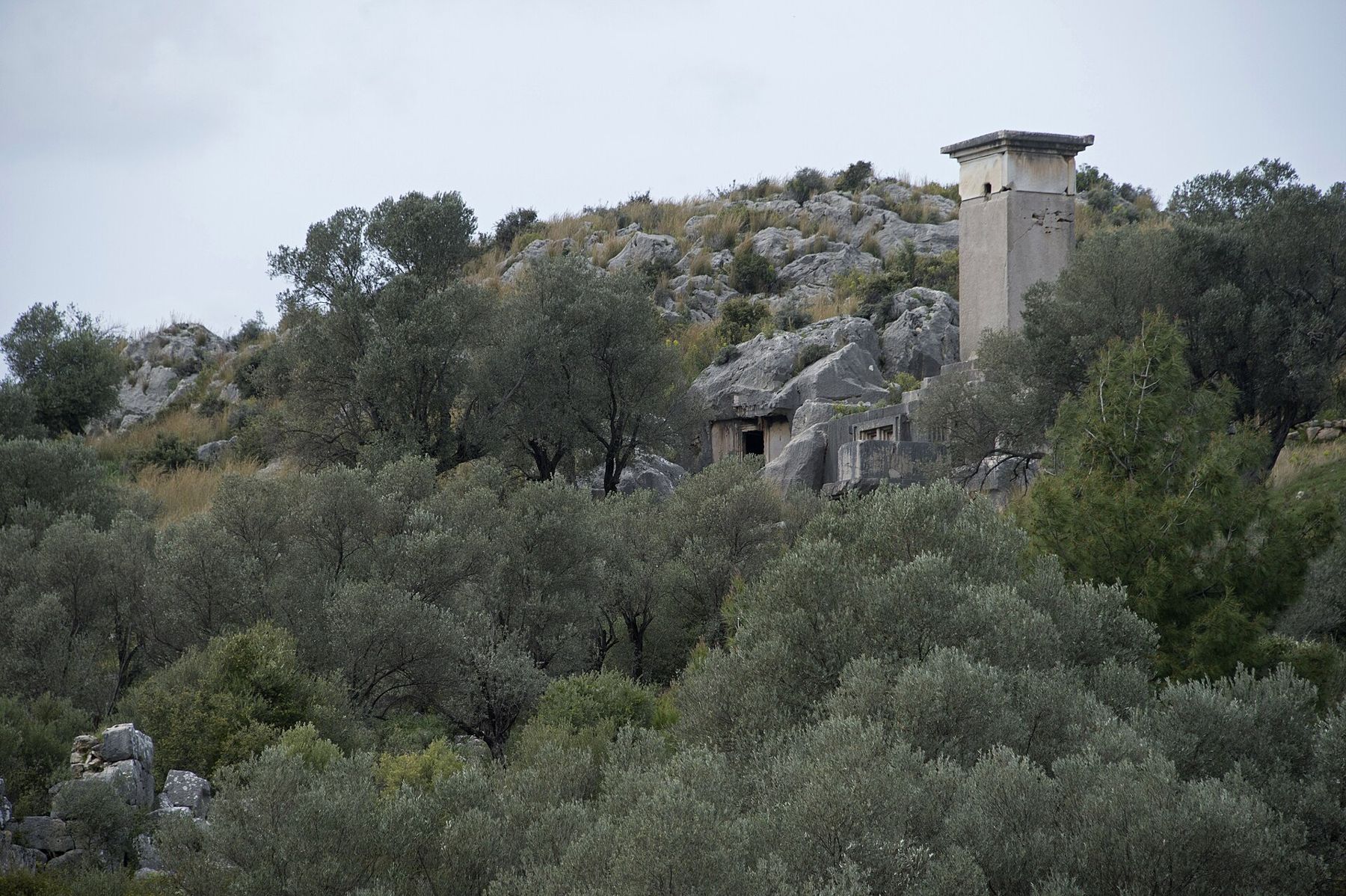
Much of Xanthos's finest sculpture, including the Nereid Monument, a temple-like tomb, was taken to the British Museum in the nineteenth century. What stays on site is the architecture and the setting, which explain how the monuments once worked.
The city went on into late antiquity, and a Byzantine basilica with mosaic floors lies within the site. Parts of the floors are often covered to protect them, but the outline of the church shows that Xanthos continued as a Christian community long after its pagan monuments were old.
The Letoon
The Letoon lies a short drive away, on low ground near the village of Kumluova. Leto, the mother of Apollo and Artemis, was worshipped here, and the sanctuary served as the religious centre of the Lycian League.
Three temples stand side by side, generally identified as those of Leto, Artemis and Apollo. The largest, to Leto, has been partly rebuilt, with columns re-erected on its platform. The smaller temples are in a more ruined state.
The Letoon is famous for the trilingual stele found here in 1973. It carries a decree in Lycian, Greek and Aramaic from the fourth century BC, and the parallel texts helped scholars make real progress with the Lycian language. The stele is now in the Fethiye Museum.
Below the temples lies a nymphaeum, a monumental fountain. The ground here is low and the water table high, so the basin is usually flooded. Frogs and terrapins live in it, which suits an old myth in which Leto turned hostile peasants into frogs.
A Hellenistic theatre stands on the slope north of the sanctuary. One of its vaulted entrance passages carries a row of carved theatre masks.
Practical notes
- Xanthos and the Letoon are separate ticketed sites. Fees, museum cards and opening hours change; check before you go.
- Allow two hours for Xanthos and one for the Letoon.
- Summer heat on the open hillside is intense and dangerous at midday. Go early or late, and carry water.
The two sites lie near the coast between Fethiye and Kalkan, and they combine well with the league's meeting hall at Patara, a short drive south. The cliff tombs of Tlos and Pinara are further up the same valley.
Before you leave Xanthos, return to the Harpy Tomb and look up. The pillar, the chamber and the carved panels, even as casts, still show how the Lycians wanted their dead to be seen: high above the city, close to the sky.