 LYCIAN STONES
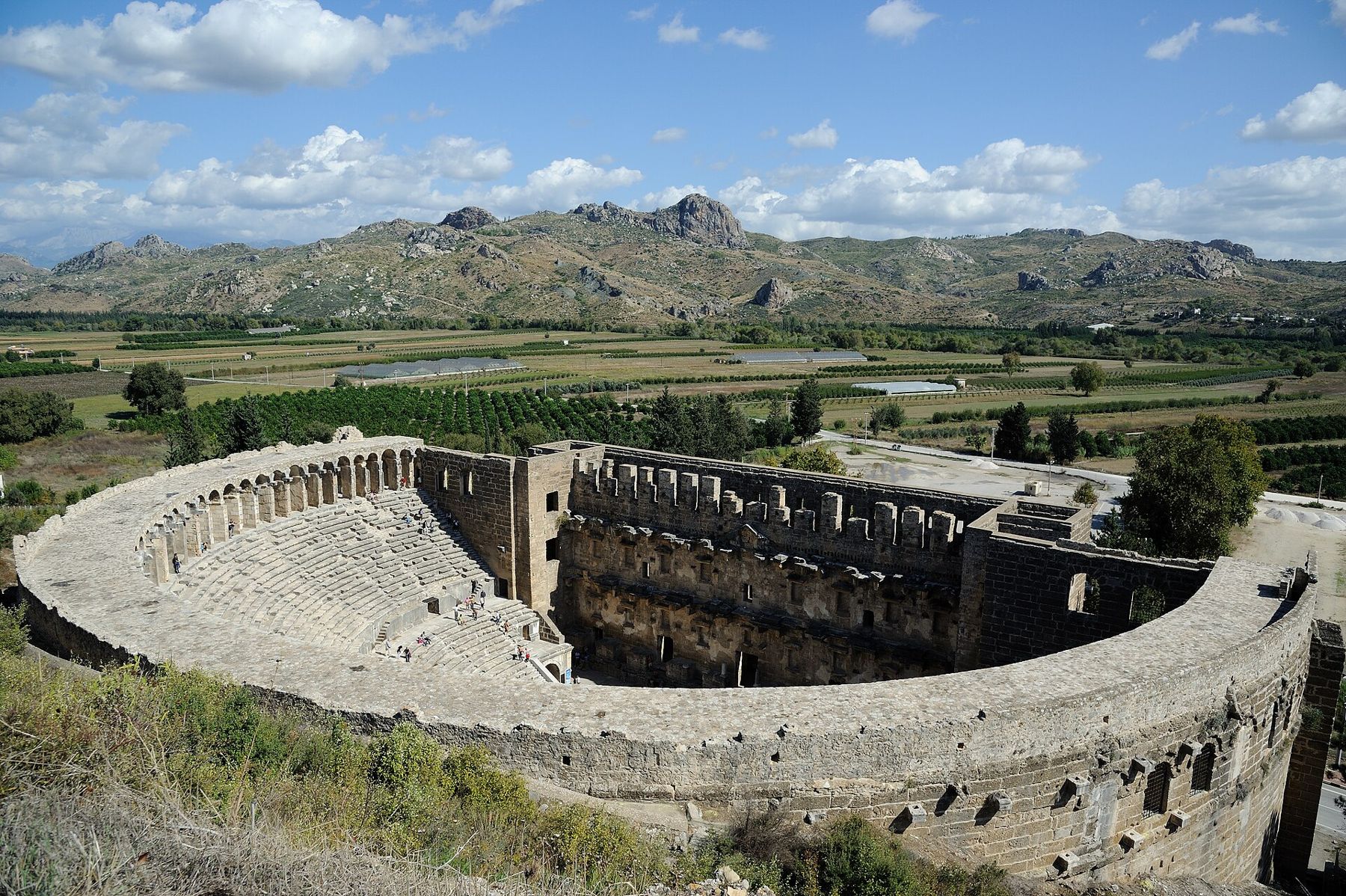
Aspendos is known for one building, and with good reason. Its Roman theatre is the best-preserved ancient theatre in Anatolia, and one of the most complete anywhere in the Roman world. The seating, the vaulted gallery that runs around its top, and above all the tall stage building survive to a degree that is hard to believe until you are inside. But the theatre is only the start. On the plain to the north an aqueduct strides across the fields, and on the flat hill behind the theatre lie the remains of the civic centre that most visitors never see.
The city stood near the river now called Köprüçay, the ancient Eurymedon, a few kilometres from the sea, which in antiquity let ships come upriver. It was an old Pamphylian city with its own coinage long before the Roman period, and the river gave its name to a famous battle in the fifth century BC between Athens and Persia. What you see now, however, is mainly Roman.
The theatre
The theatre was built in the second century AD, in the reign of Marcus Aurelius. An inscription names the architect as Zenon, a son of the city, and records that the building was paid for by two local brothers. The seating is cut partly into the hillside and partly built up on vaults, in the Roman way, and it rises in two main tiers divided by a walkway. Estimates of its capacity vary, but it seated several thousand people, perhaps around seven thousand.
What sets it apart is the stage building, the scaenae frons. In most ancient theatres it has fallen to a stump. Here it stands to its full height, a long wall of stone with doors at ground level and rows of windows and niches above, once framed by two storeys of columns. You can still see the sockets and supports where the columns and a timber roof over the stage were fixed. Near the top, a carved pediment shows a figure usually identified as Dionysos.
Here it stands to its full height, a long wall of stone with doors at ground level and rows of windows and niches above, once framed by two storeys of columns.
The reason it survived is that it never stopped being used. In the Seljuk period of the thirteenth century the theatre was adapted as a palace or caravanserai, and the stage building was repaired and painted. Traces of red zigzag decoration from that time are still visible on the stage wall. Walk up the stairs to the top gallery and look down: the acoustics are good enough that a voice from the stage carries clearly, and the theatre is still used for performances in some seasons.
Notice the details of the seating as you climb. The front rows, closest to the orchestra, were reserved for the most important citizens,. The stairways divide the seating into wedges, and the arched gallery at the top, running the full width of the auditorium, both framed the building and gave shaded standing room. From the gallery you also see how tightly the seating and the stage building lock together into a single enclosed space, a design that is Roman rather than Greek.
Time your visit with care. The theatre is the centre of most coach itineraries, and the middle of the day can be crowded. Early in the morning or late in the afternoon the stone takes on a warmer colour and you are more likely to have a section of the seating to yourself.
The aqueduct on the plain
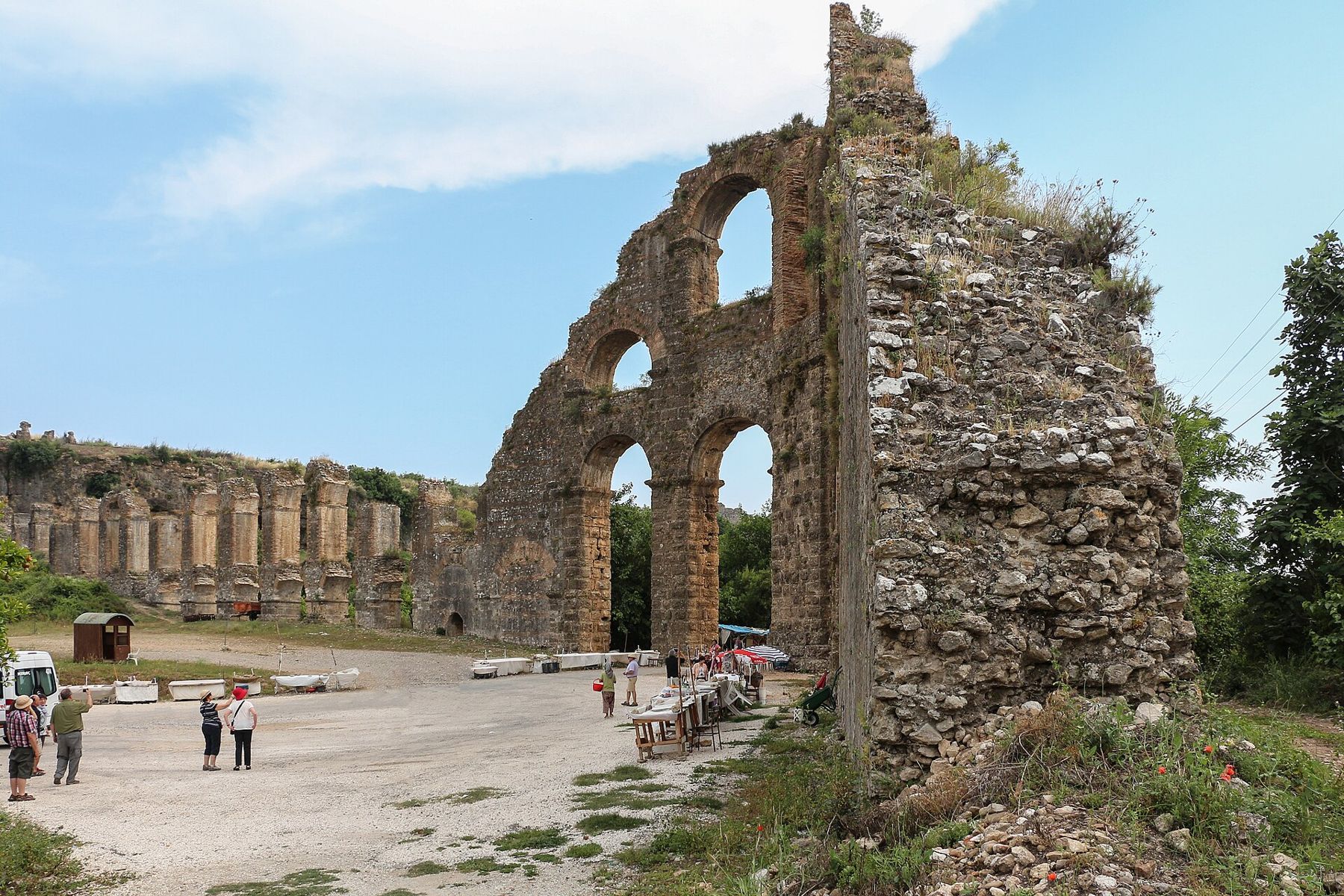
From the top of the theatre you can see a line of arches crossing the plain to the north. This is the aqueduct of Aspendos, one of the best-preserved Roman aqueducts in Anatolia, and it is worth the short drive or walk to stand beneath it. It brought water from the hills to the north across the low ground to the city on its hill.
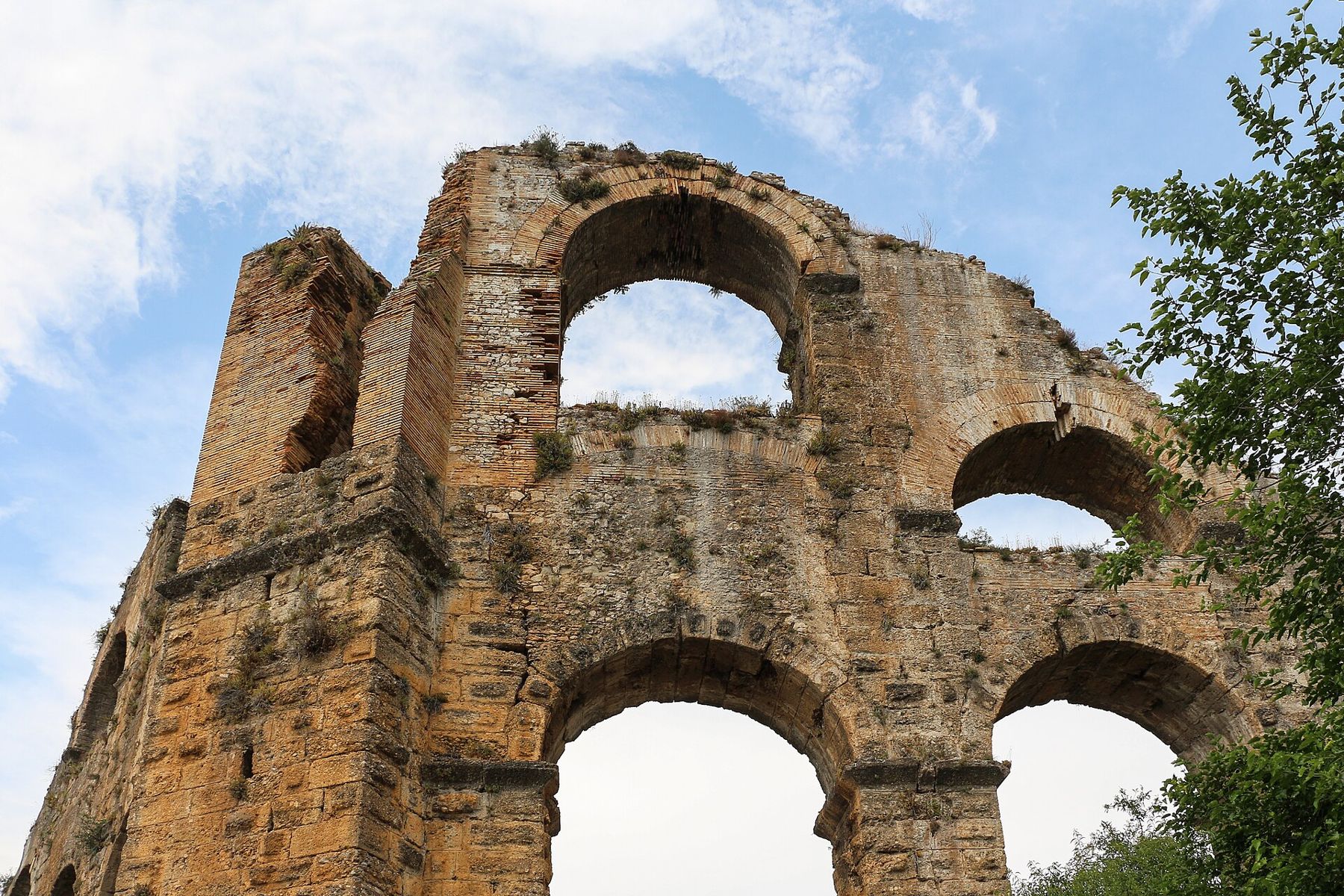
Its interest is engineering. Instead of keeping a gentle gradient all the way, the builders used the principle of an inverted siphon: water travelled in pressurised pipes across the plain and rose through two tall towers, one at each end of the bridge-like section of arches, which helped to manage the pressure. The towers still stand, and their size makes sense once you know what they did.
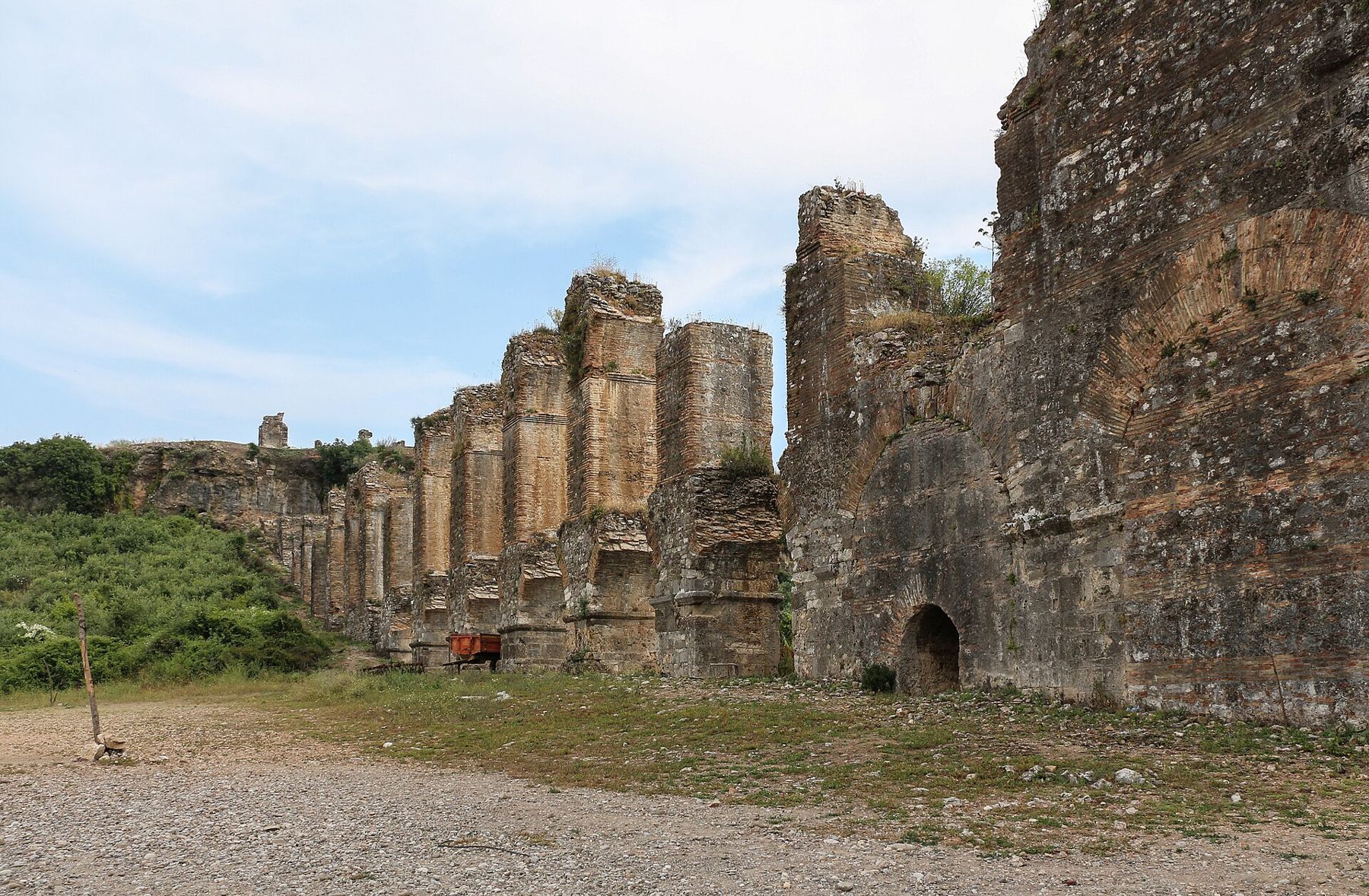
The section of arches is long, and you can follow it on foot for some distance. Parts of the arches have fallen, and in places you see brick and rubble repairs among the cut stone. There is usually no fee to see the aqueduct from the road, but access arrangements change.
The acropolis few people climb
Behind the theatre, a path climbs the flat-topped hill that held the city's civic centre. It is short but steep and stony in places, and most visitors skip it, which is exactly why it is worth doing. At the top you walk across an open plateau of scattered remains with long views over the plain and the river.
The largest standing ruin is a basilica, a long hall that served as a law court and meeting place, with a tall end wall still rising high. Nearby are the remains of the agora, a market hall with a row of shops, and a nymphaeum, a monumental fountain whose façade of niches still stands. A council house and other buildings can be traced in outline.
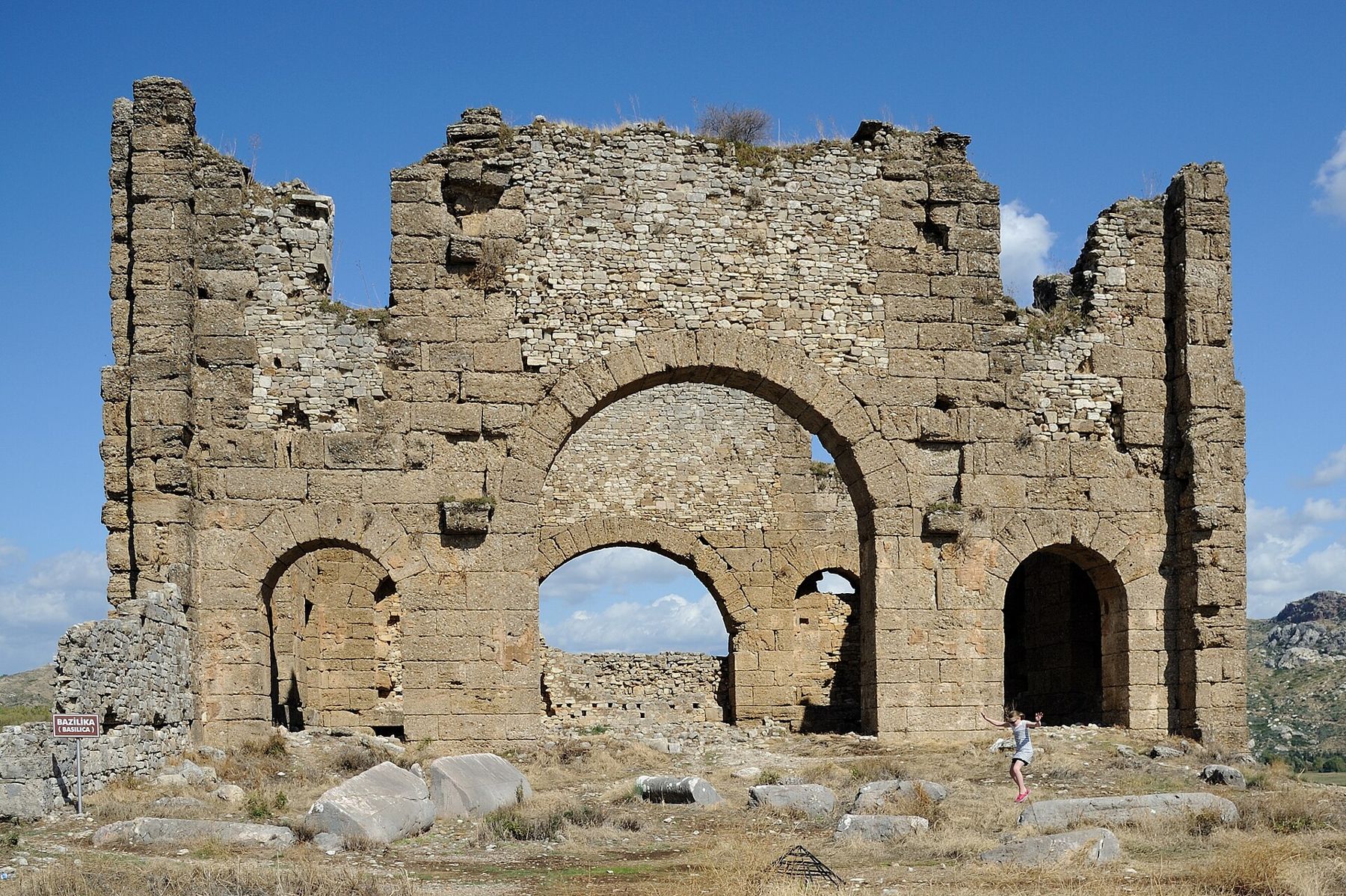
None of this is restored in the way the theatre is, and paths are faint. Wear proper shoes, take water and avoid the climb at midday in summer. In return, you get the sense of a whole city, not only its most famous building.
Practical notes
- The theatre and acropolis are on one ticketed site; fees, museum cards and opening hours change, so check before you go.
- Allow at least an hour for the theatre, more for the acropolis and the aqueduct.
- Summer midday on the acropolis is exposed and dangerous in heat; carry water.
- Near the village below the site, a stone bridge over the Köprüçay stands on Roman foundations, rebuilt in the Seljuk period.
Aspendos sits between Antalya and Side, and it combines well with the colonnaded street of Perge or the temples of Side. If you want to compare theatres, the one at Termessos is the opposite: smaller, high on a mountain, with the landscape as its stage set.
If you only have time for the theatre, sit for a while near the top gallery. Look at the stage wall, then out at the plain and the line of the aqueduct. Water, stone and spectacle: that was what a Roman city in Pamphylia promised its citizens, and at Aspendos you can still see all three from one seat.