 LYCIAN STONES
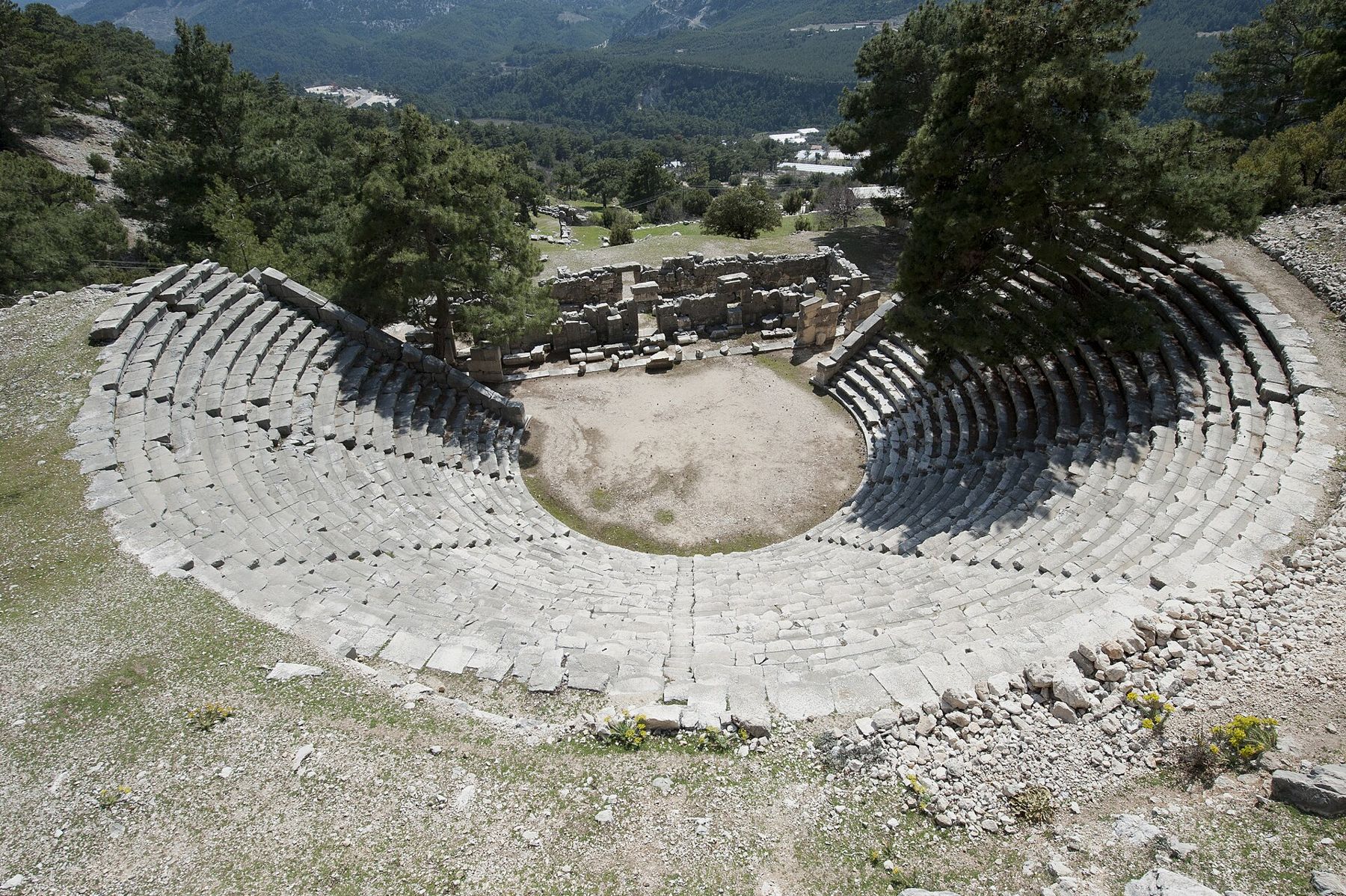
Arykanda lies inland from the coast of eastern Lycia, on a steep mountainside above the village of Arif, along the road that climbs from Finike towards the high plain of Elmalı. The city was not laid out on a flat grid. It was built in terraces, one stepped platform above another, so that walking through it means climbing, and almost every public building looks out over the same deep valley of pines.
That setting is the reason to come. Arykanda is far less visited than the coastal sites, and on a spring morning you may share it with a handful of people. The ruins are substantial: a theatre, a stadium, a large bath building with standing walls, a market square, council and civic buildings, churches and a scatter of tombs. Most of what you see belongs to the Roman and early Byzantine centuries, set on terraces that are older still.
A mountain city with an old name
The name ends in -anda, a pattern shared by several place names in southern Anatolia that are older than Greek. That ending is usually taken as a sign that the settlement goes back to the native peoples of the region, before Greek became the language of public inscriptions here. How early the first village stood on this slope is not known in detail, but excavation has found material from the Lycian centuries, and the city later belonged to the Lycian League alongside its larger neighbours on the coast.
In the Roman period Arykanda prospered. The bath buildings, the paved streets between the terraces and much of the decoration date from these centuries. Later, in the Byzantine period, churches were built among the older public buildings. Earthquakes and the general shrinking of towns in late antiquity took their toll, and the life of the valley moved downhill. Excavations since the 1970s have cleared much of the city and continue to add detail.
The lower terraces: baths and churches
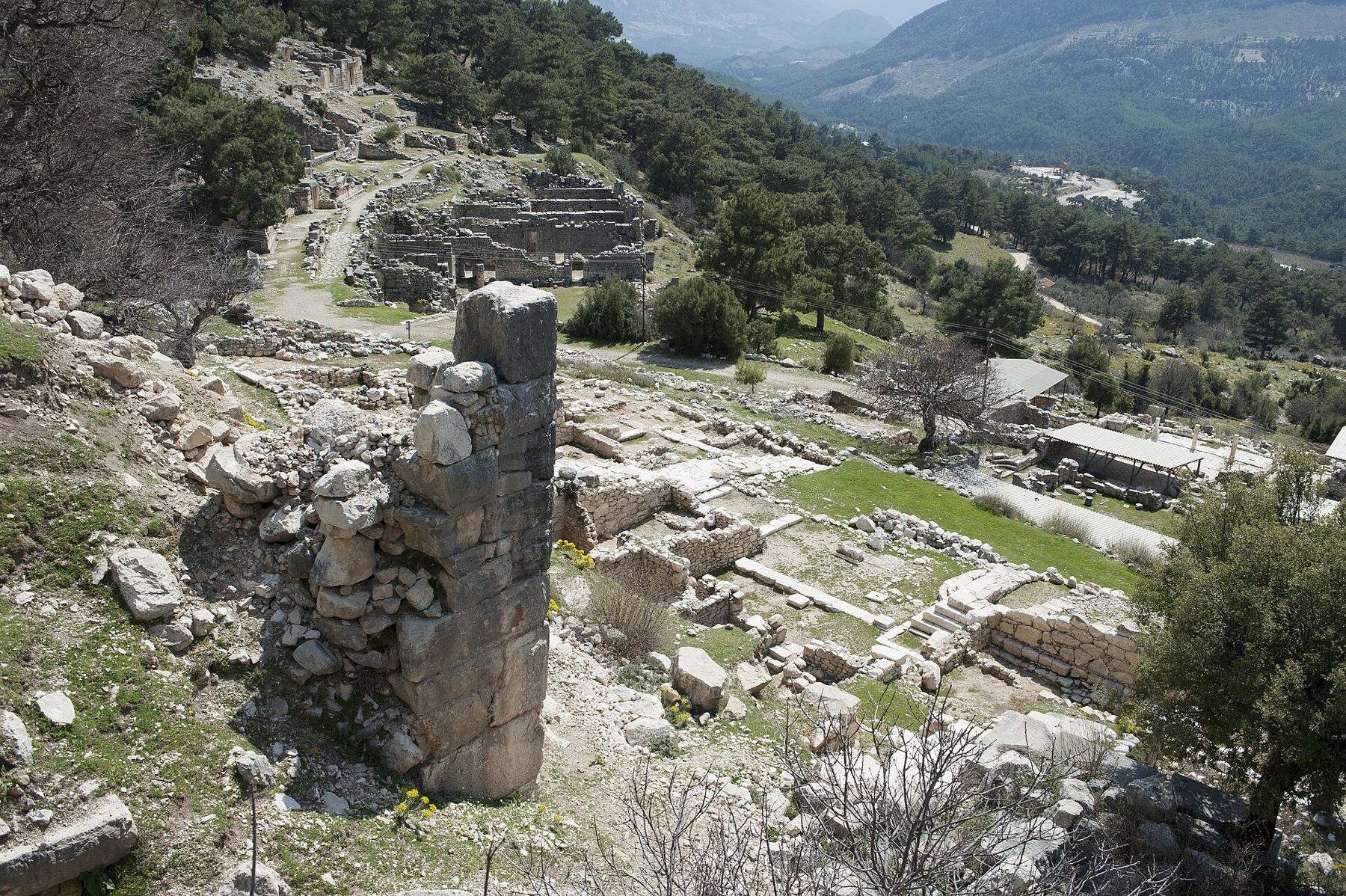
You enter on the lower part of the site. The building that dominates this level is the Great Bath, its wall standing to a remarkable height, pierced by tall window openings that look over the valley. Walk along it and you can follow the sequence of rooms a Roman bather moved through, from cooler to hotter halls. Nearby, a smaller bath and a gymnasium complete the picture of a town that cared about this part of daily life.
Among these buildings you find the remains of Byzantine churches, some with mosaic floors protected under modern shelters. Their presence here, in the middle of the Roman civic quarter, tells the later story of the city in a single glance: the same terraces, reused for a different public life. Look for the line of a basilica's apse and the change in masonry where later builders patched older walls.
Above the baths a set of houses with courtyards has been excavated, including a large residence built around a peristyle, a courtyard ringed with columns. These rooms are a reminder that Arykanda was not only temples and theatres but a place where families lived, cooked and stored water on a slope where every flat metre had to be built.
The agora, the odeion and the civic heart
Climb a level and you reach the civic centre. The agora, a market square framed by porticoes, opens on a terrace with the small roofed hall of the odeion along one side. An odeion was used for music, recitals and probably for meetings; its rows of seats are compact compared with the theatre above. Close by stand buildings identified with the city council and its magistrates, and the shapes of their rooms are easy to read from the paths.
Here, as at other cities of the league, public life was conducted in stone. Inscribed bases once carried statues of benefactors and officials, and fragments of their texts lie around the terraces. If you have seen the council house at the league's meeting place at Patara, the scale here will feel modest, which is exactly the point: Arykanda was a mid-sized hill city with the same institutions in miniature.
The theatre and the stadium above it
A steep path leads up to the theatre, cut into the hillside with its seats facing across the valley. It began as a Hellenistic theatre and was reworked in the Roman period, when the stage building was added in front of it. The seating is in good condition, and from the top rows you can see how the whole city falls away below you in steps.
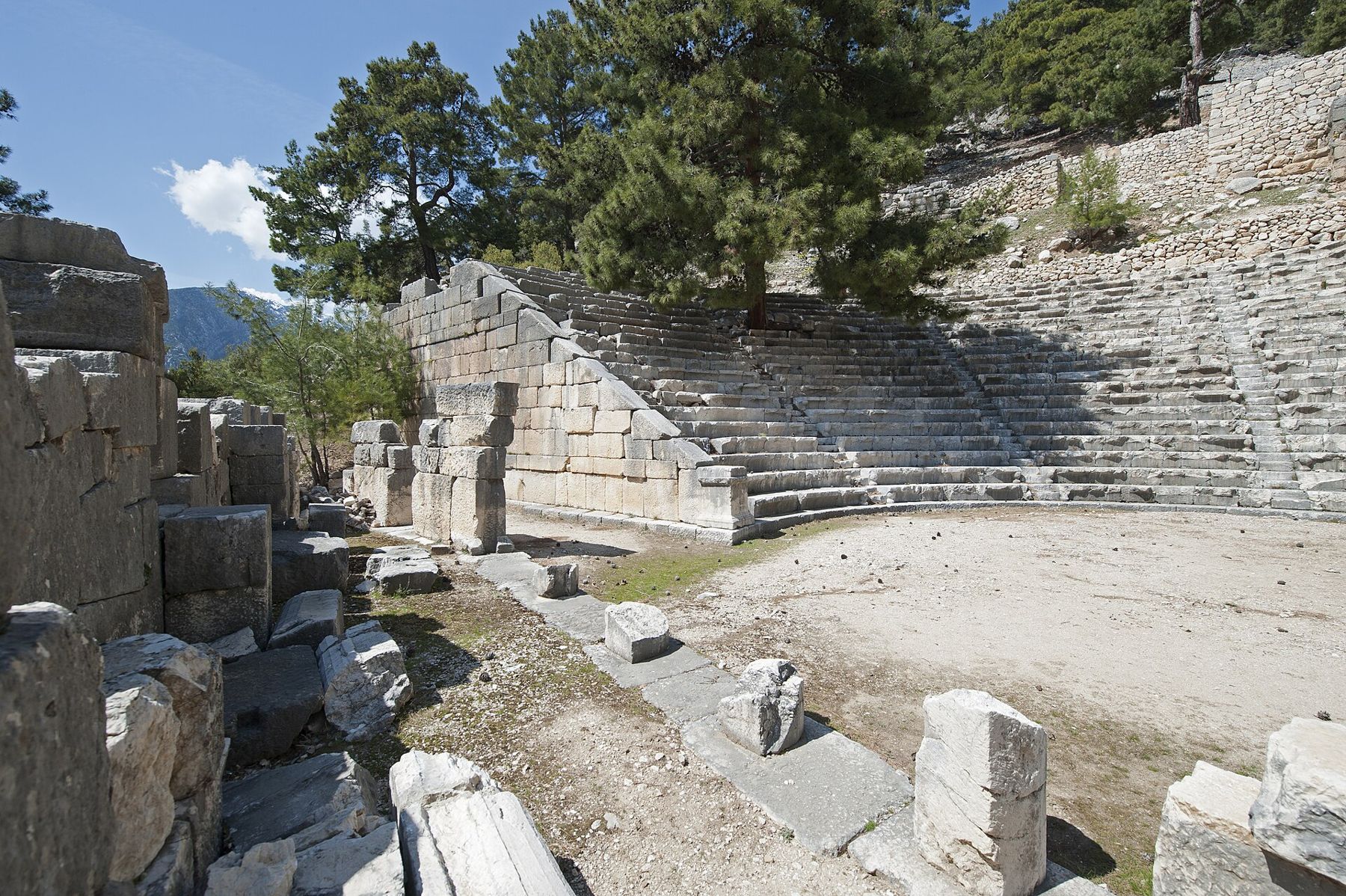
Above the theatre, on a narrow terrace, lies the stadium. It is short and simple compared with the great stadium at Perge on the Pamphylian plain, with seating along one side, but its position, high on a mountainside, is part of its interest. The builders of Arykanda took a slope that suited goats and gave it a running track.
Tombs on the edges
As in most Lycian cities, the dead were kept close. Tombs lie along the approaches and on the slopes around the city: temple-fronted tomb buildings, sarcophagi and simpler graves. Some are monumental, with façades that copy the front of a small temple. They are later and more Roman in style than the rock-cut house tombs of the coast, and comparing them is a good exercise if you are learning how to read a Lycian tomb.
The cemeteries are less cleared than the centre of the site, and paths may be faint. Keep to marked routes where they exist, and watch your footing among fallen blocks and thorny scrub.
Planning your visit
Arykanda is a visit for half a day. The site stands several hundred metres above sea level, so it can be noticeably cooler than the coast, and on spring mornings the air is fresh while Finike is already warm. In summer the climb between terraces is still hard work in the heat, and shade is patchy, so go early and carry more water than you think you need. Facilities on site are limited; plan for that.
- Allow two to three hours to walk up through the terraces to the stadium and back.
- Wear shoes with grip: steps are uneven, paving is polished and loose stones are common.
- Entry fees, opening hours and any museum card arrangements change; check before you go.
- Combine the visit with the coast below: the rock tombs of Myra lie a short drive away.
The road up from Finike follows a river valley into the mountains, and the turning for the site is signposted near the village. Public transport on this road exists but is not frequent, so most visitors come by car. However you arrive, give yourself time at the top: the view across the valley from the theatre is the part of Arykanda that stays with you longest.