 LYCIAN STONES
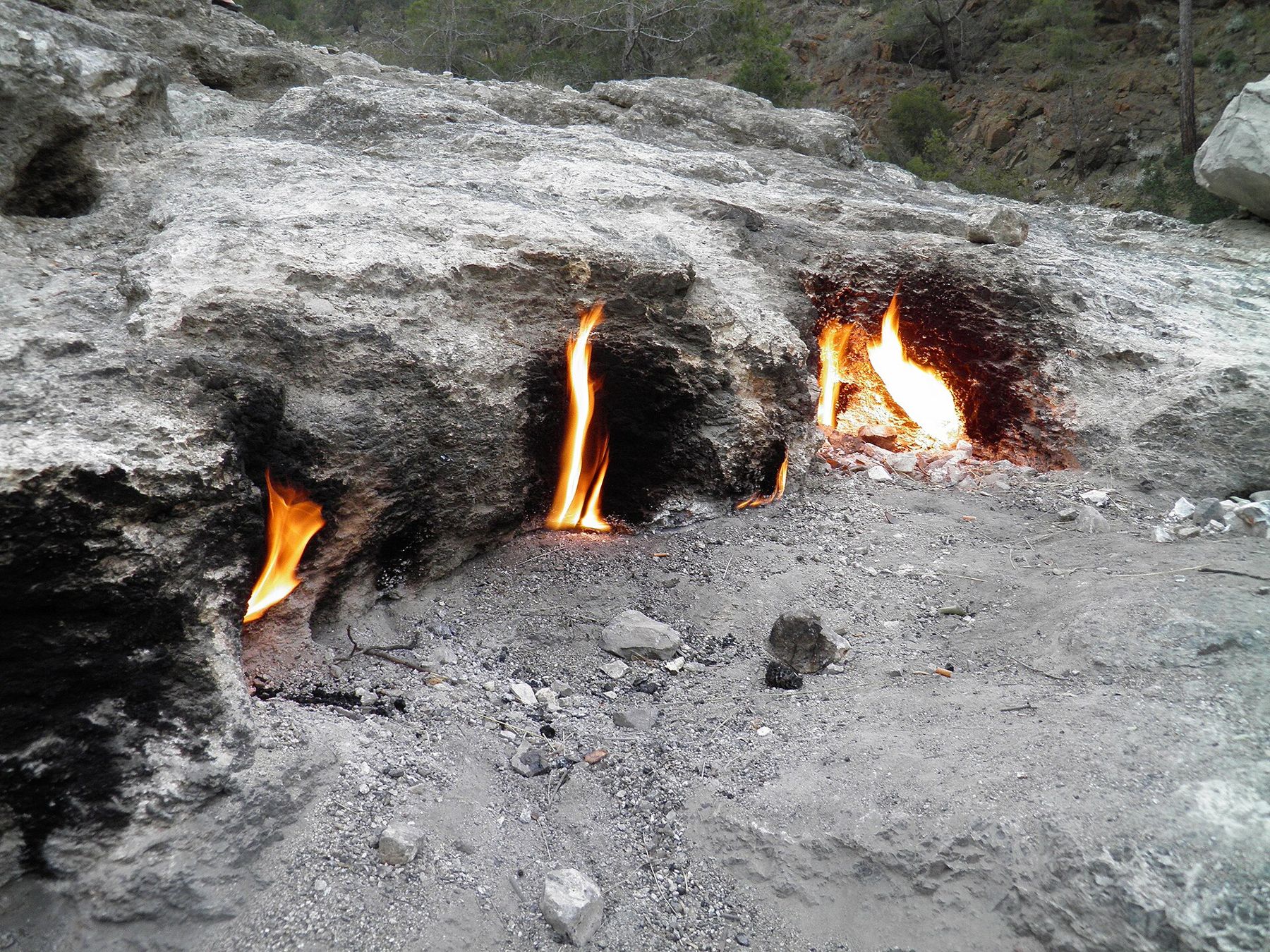
Olympos is two experiences joined by a short stretch of coast. The first is the ancient city: ruins scattered along both banks of a stream that runs to the sea, overgrown with laurel, figs and plane trees, with tombs, a temple doorway and a theatre among the leaves. The second is the Chimaera, a patch of hillside above the village of Çıralı where gas seeps from the rock and burns in small, steady flames that have been noticed and written about since antiquity.
See the city by day and walk up to the flames towards evening, when they show best against the dark.
A city in a stream bed
Olympos was a Lycian city with a harbour at the mouth of its valley. By the second century BC it was one of the leading members of the Lycian League, one of the six cities with the largest number of votes. In the early first century BC it was taken over by pirates, and the Romans captured it in their campaigns against piracy along this coast. It recovered under Roman rule, and the great majority of what you see is Roman and Byzantine, with medieval walls on the hills at the river mouth.
The setting is the attraction. The stream has cut a narrow valley, the vegetation is thick, and the buildings appear suddenly: a wall in the bushes, a vaulted room, a sarcophagus at the edge of the path. In spring there is water in the stream; in summer it may be almost dry, and the shade of the trees is welcome.
What to look for among the trees
Several things stand out as you follow the paths along the valley.
- The temple doorway: a tall, carefully cut stone door frame from a Roman temple, still standing on its own in the trees, the rest of the building fallen around it.
- The necropolis: tombs and sarcophagi along the slopes near the river mouth, some with inscriptions in Greek and a few with carved reliefs.
- The theatre: partly ruined and overgrown, with its vaulted entrance passages still standing.
- The baths and a Byzantine church, with fragments of floor mosaic in places.
- The walls on the hills by the shore: medieval fortification built on older foundations, overlooking the beach.
Paths and boardwalks have been improved in recent years, and some areas may be closed while excavation and conservation go on. A slow loop of the main valley takes around two hours. If you know the tombs at Myra or the cliffs of Tlos and Pinara, compare: here the tombs are freestanding and scattered, not cut into a single cliff.
The sea at the valley mouth
The valley opens onto a long beach of pebbles and sand that runs south to Çıralı. The coast here is protected, and the beach is a nesting place for loggerhead turtles; follow the posted rules, especially after dark in the nesting season. The ruins and the beach access at Olympos usually share a ticket arrangement, which changes; check before you go.
The Chimaera: fire from the rock
Above Çıralı, on a hillside of scrub and pine, gas escapes from cracks in the rock and burns. The site is known in Turkish as Yanartaş, the burning stone. The flames are small, usually a few handfuls of them, flickering from dark, sooty hollows in the ground; some years there are more, some fewer. The gas is natural, mostly methane, coming up through the rock, and the flames have burned here for at least the whole recorded history of the coast. Ancient writers knew them, and the place became linked with the myth of the Chimaera, the fire-breathing monster killed by the hero Bellerophon.
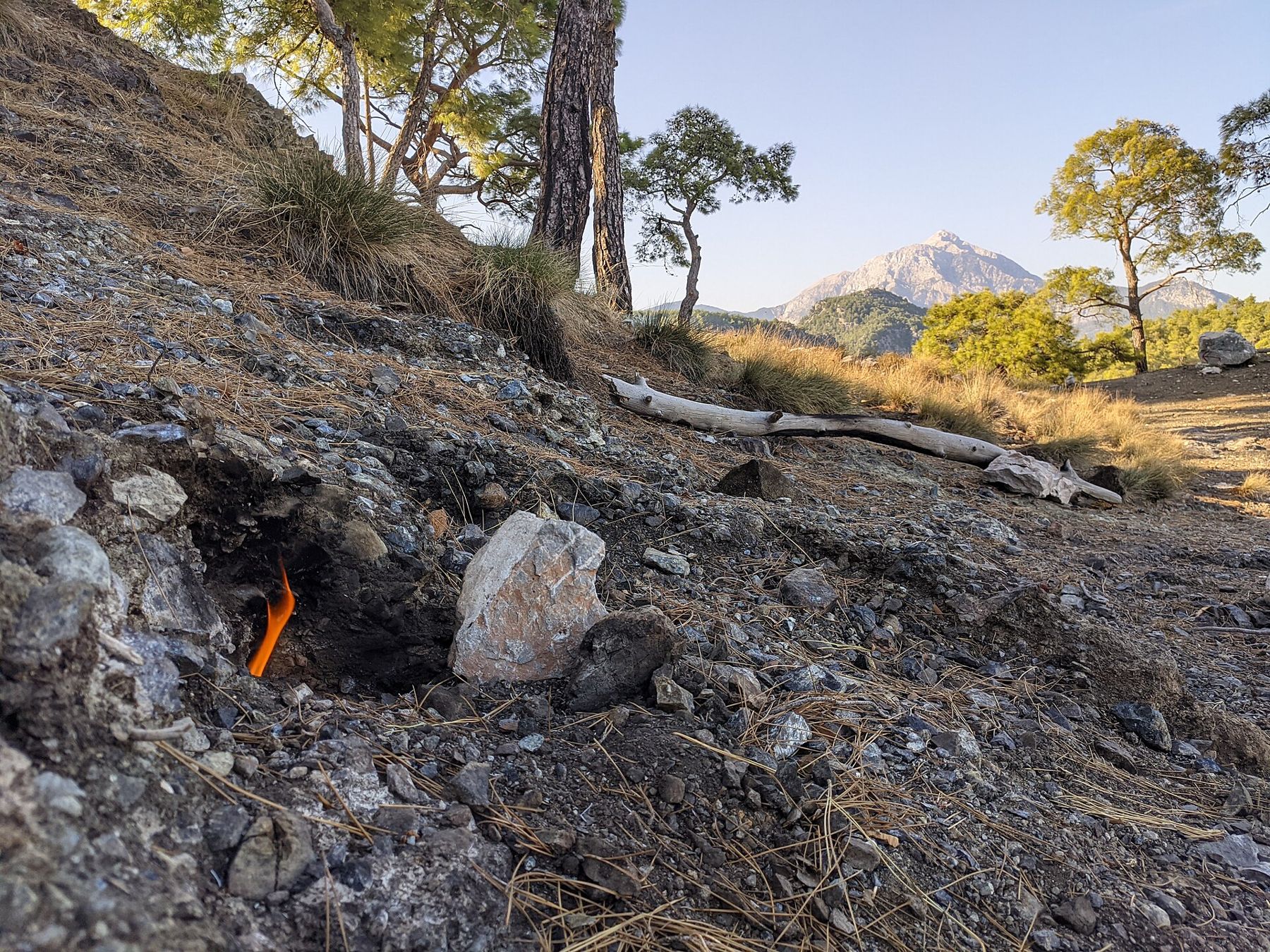
Near the flames are the remains of a sanctuary, associated with Hephaestus, the god of fire, and a later Byzantine church. They are modest, but they show that the place was treated as sacred long before it was a sight to visit.
Walking up at dusk
The path to the flames starts from a car park at the end of the road inland from Çıralı. It is a climb of a little under a kilometre on stone steps and a rough path through the pines, steep in places; allow around half an hour up at an easy pace. Going up in the late afternoon and staying into dusk is the classic visit: the flames look pale in daylight and bright orange once it gets dark.
- Bring a torch for the walk down; the path is uneven and not lit.
- Wear shoes with grip; the steps can be slippery with dust and pine needles.
- Keep children close to the vents, and keep clothing and hair away from the flames.
- There is a small fee at the start of the path; the amount changes, so check before you go.
Many people visit in the evening, so in summer the path can be busy at dusk. Spring and autumn are quieter, with cooler air for the climb and earlier sunsets.
Getting there and combining visits
Olympos and Çıralı are reached by roads branching down from the main coast road between Antalya and Kumluca, through the pine-covered mountains of the Olympos Beydağları National Park. Public transport is limited; check current minibus services before relying on them. The two places are linked along the beach on foot, which is the pleasant way to go between them when the river is low enough to cross.
Olympos lies along the line of the Lycian Way, which passes through Çıralı and climbs past the Chimaera towards the mountains; the stretch around the flames is one of its best-known. And the ruins of Phaselis, by the sea further north, make a natural pairing for a second day on this coast.